Radio or Satellite Check-Ins With a Pilot
Stepping into the vastness of Alaska’s backcountry, whether by floatplane, wheel plane, or helicopter, is an experience unlike any other. But that sheer wildness, that incredible isolation, also brings with it a very real concern: how do you stay connected, and more importantly, how does anyone know you’re okay? For many hunters, the worry about being truly alone in an emergency can be a significant source of anxiety. That's why establishing clear and reliable radio or satellite check-in protocols with your pilot isn't just a good idea; it's a lifeline, offering peace of mind and a crucial layer of safety for your Alaskan adventure.
Why Regular Pilot Check-Ins Are Non-Negotiable in Alaska
When you venture into Alaska’s wilderness, you're not just stepping off a paved road; you're often entering a world with no cell service, no established trails, and weather that can change its mind in minutes. This isn't like hunting the lower 48 where you might eventually stumble upon a ranch road or get a bar of signal from a distant town. In Alaska, you are truly on your own, and the vast distances mean that if something goes wrong, help isn't just around the corner.
The Sheer Scale of Alaskan Wilderness
Imagine being dropped off in a remote drainage, miles from the nearest human settlement, perhaps even hundreds of miles from the closest road. The landscape here is immense, sprawling, and unforgiving. A sudden whiteout can ground aircraft for days. A seemingly minor injury, like a twisted ankle, becomes a critical situation when you're days of hiking from extraction. Without a way to communicate your status, even if you have an emergency device, the pilot who dropped you off has no idea whether you're safe and just enjoying the solitude, or if you're in dire straits.
It’s easy to underestimate the isolation until you’re truly immersed in it. The silence can be profound, and while that's part of the draw, it also underscores the reality that you are a small speck in an enormous, wild system. Your pilot, who is effectively your last link to the outside world, needs to know you're still out there and functioning. This mutual understanding forms the backbone of any safe remote Alaska hunt.
Safety and Emergency Preparedness
At its core, regular check-ins are about safety. Let's say you're packing out a moose through a particularly swampy section and slip, injuring your leg badly. Or perhaps your camp stove malfunctions, leading to a small fire that damages some critical gear. These aren't life-or-death situations instantly, but they can become so very quickly if you can't communicate. An SOS button on a satellite messenger is fantastic, but it only tells someone you're in trouble, not what kind of trouble, or how long you've been okay up until that point.
A regular check-in provides a continuous stream of "all clear" messages. If that stream suddenly stops, it’s a clear indicator that something might be amiss, prompting your pilot or designated contact to investigate. This proactive approach significantly cuts down the time it might take for help to arrive, potentially saving lives or preventing minor issues from escalating into full-blown crises. It's an integral part of any robust Emergency Evacuation Plans in Remote Alaska.
Logistics and Weather Adaptability
Alaska's weather is notoriously fickle. You might depart under clear, blue skies, only for a storm to roll in hours later, blanketing your pick-up point in fog or torrential rain. Your pilot needs current, on-the-ground weather observations from your specific location to plan their flights, especially for resupply or pick-up. A quick text or radio call saying, "Cloud ceiling is about 1,000 feet here, light rain," is invaluable for their decision-making.
Beyond weather, check-ins help manage the logistics of your hunt. Maybe you tagged out early and are ready for an early pickup. Perhaps you need a resupply of fuel or food. Or maybe you've decided, due to challenging conditions, that you need to extend your hunt by a day or two, which means the pilot needs to adjust their schedule accordingly. This communication flow is a critical part of Fly-In Hunting: Working With an Alaska Transporter Pilot and ensuring flexibility, especially if you've already started thinking about Building Extra Days Into a Fly-In Schedule for potential delays. Without these routine updates, your pilot is flying blind, and that creates unnecessary risks and inefficiencies for everyone involved.
Choosing Your Communication Method: Radio vs. Satellite Device
When planning your remote Alaska hunt, you’ll encounter various communication options, each with its own strengths and limitations. The choice often depends on the specific demands of your trip, your budget, and the level of connectivity you desire. For true peace of mind and reliable pilot check-ins, a multi-faceted approach often works best.
VHF Radios: Line-of-Sight Limitations
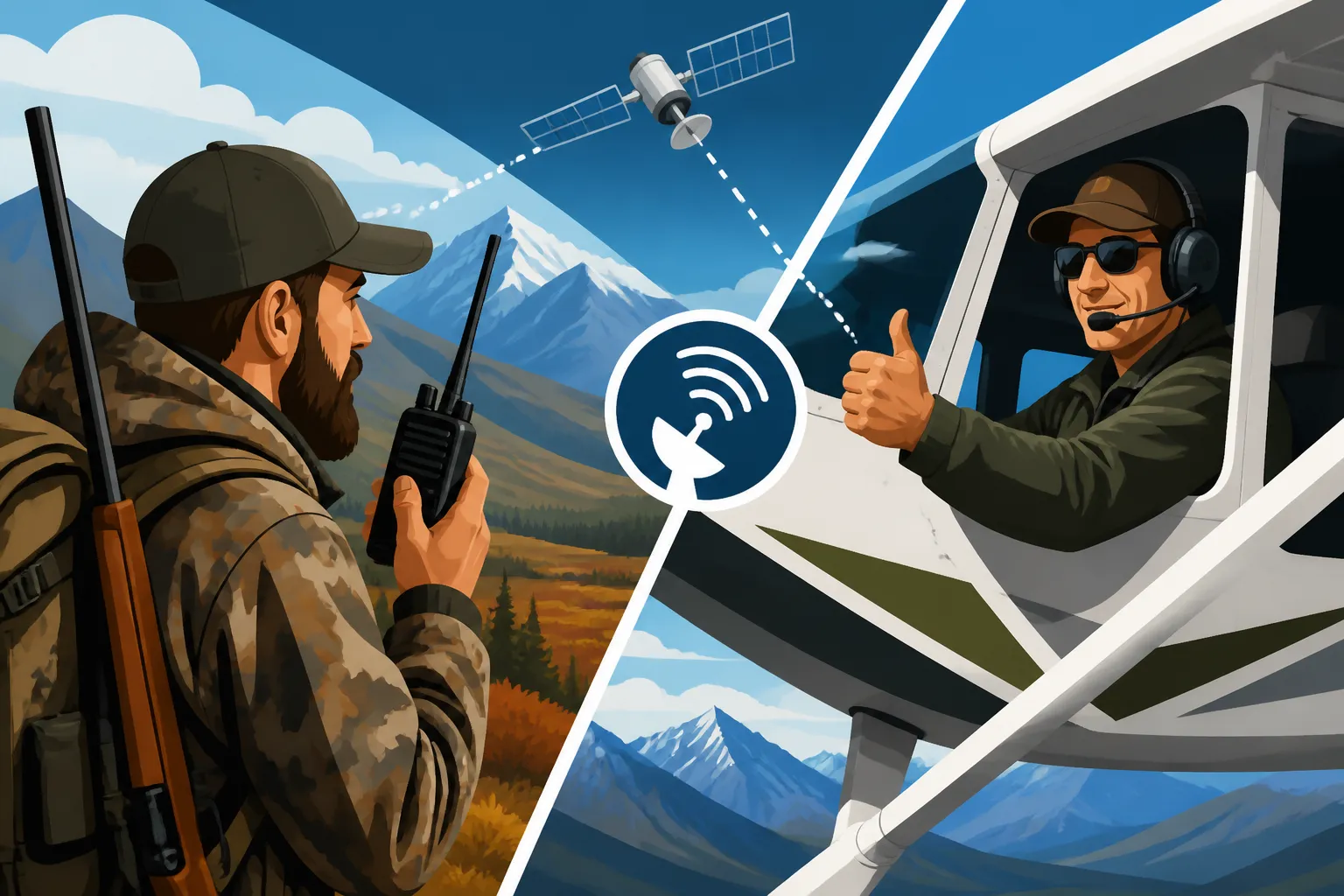
VHF (Very High Frequency) radios are common in aviation and are excellent for short-range, line-of-sight communication. Pilots often carry handheld VHF radios, and some hunters opt to carry one too, tuned to the aircraft frequency their pilot uses. If your pilot is flying directly overhead or within a few miles of you without significant terrain obstructions, a VHF radio can provide crisp, immediate voice communication.
However, the "line-of-sight" aspect is a critical limitation. If you're tucked away in a valley, behind a mountain, or too far from the aircraft, that signal simply won't reach. This makes VHF unreliable for daily scheduled check-ins from a static camp unless you know your pilot will be flying directly over you at a specific time and you have a clear shot to the sky. While a VHF radio can be a good backup for specific, close-range needs, it's generally not sufficient as your primary means of daily communication with your pilot in the vast, rugged terrain of Alaska.
Satellite Messengers and Phones: The Modern Lifeline
For truly reliable communication across Alaska’s expansive wilderness, satellite devices are the undisputed champions. These compact gadgets use satellite networks to send and receive messages, track your location, and most importantly, trigger an SOS if you’re in a genuine emergency. Brands like Garmin inReach and Zoleo are practically standard gear for anyone venturing deep into the Alaskan bush.
Satellite messengers offer two-way text communication, allowing you to send detailed messages to your pilot or a designated contact, and receive replies. This is ideal for those routine check-ins, conveying weather updates, or discussing pickup logistics. Many devices also allow pre-programmed messages (e.g., "All OK," "Camp is set up," "Need a call"), which can save on message costs. While they do require a subscription and have battery life considerations, the peace of mind they offer is immeasurable. These devices are central to any comprehensive Signal Devices and Check-In Plans for Solo Alaska Hunts, ensuring you always have a link to the outside world, no matter how remote you are. Many outfitters listed on platforms like BookYourHunt or GoHunt will strongly recommend, or even require, that their clients carry one.
Satellite Phones: When Cost Meets Critical Need
For those who need the capability of direct voice communication from anywhere on the planet, a satellite phone is the next step up. These devices provide a true phone connection, allowing you to have a conversation rather than just exchanging texts. This can be invaluable for complex situations where nuances in communication are important, such as describing an injury, coordinating intricate logistics, or speaking directly with emergency services.
The trade-off, however, is cost. Satellite phones are significantly more expensive to purchase or rent, and their call plans are considerably pricier than satellite messenger subscriptions. They are also generally bulkier and heavier. While some guides or larger hunting parties might opt for a satellite phone as their primary communication, for the average hunter focused on daily check-ins, a satellite messenger usually strikes a better balance between capability, cost, and portability. It's a robust solution but often an overkill for merely conveying "all good" messages unless you're managing a very complex operation or have a very specific need for voice communication.
Setting Up a Reliable Check-In Schedule
Having the right communication device is only half the battle; establishing a clear, mutually understood check-in schedule with your pilot is equally, if not more, critical. This isn't just a casual agreement; it's a vital part of your safety net, and it needs to be treated with the seriousness it deserves.
Agreeing on Specific Times and Frequencies
Before your boots ever touch the remote gravel bar or tundra, you need to sit down with your pilot and nail down an exact check-in schedule. This conversation should cover:
- Primary Check-in Times: Agree on specific times each day (e.g., 8:00 AM and 6:00 PM Alaska Time). Pick times that are realistic for both you and your pilot.
- Backup Check-in Times: What if something prevents you from making the primary check-in? Have a secondary window (e.g., "If I miss 6 PM, I'll try again at 8 PM").
- Method of Communication: Be explicit. "I'll send a satellite text to your specific number," or "I'll be on VHF channel 12 when you fly over."
- Pilot’s Response: Ask how the pilot will confirm receipt. Will they send an "OK" text back? Will they acknowledge on VHF?
It's absolutely crucial that both parties write this down. Don't rely on memory. A simple misunderstanding about a time zone, or whether a text is expected versus a radio call, can lead to unnecessary worry. Remember, your pilot is likely juggling multiple clients and flights, so clear, concise communication helps them immensely.
The Importance of a Designated Contact Person
While your pilot is your direct link, having a reliable designated contact person back home is an absolutely essential layer of redundancy. This individual, often a spouse, trusted family member, or close friend, acts as your home base monitor. They should have:
- Your detailed itinerary, including your drop-off and pickup locations and dates.
- Your pilot's contact information.
- Your satellite device number or email address.
- A copy of your agreed-upon check-in schedule with the pilot.
Their role is to monitor your check-ins, whether you're sending messages directly to them or they are merely confirming with the pilot that you've checked in. If you miss a scheduled check-in with the pilot, or if your satellite message to the pilot fails, this designated contact becomes the alarm bell. They can then attempt to reach you, contact the pilot, or initiate further steps if needed. This system creates a vital fail-safe, ensuring that if one communication link falters, another is ready to activate. It’s part of Leaving a Trip Plan With a Contact and sharing all pertinent information with someone you trust implicitly.
Communicating Changes and Delays
The Alaskan wilderness rarely adheres to schedules. Weather shifts, a successful hunt might mean an early pack-out, or unexpected challenges could cause delays. It’s imperative to communicate any significant changes to your pilot as soon as safely possible, rather than waiting for your next scheduled check-in.
If a major storm rolls in and you anticipate being unable to make your regular check-in, send a message ahead of time. If you've got your bull down and you're ready for pickup a day early, let your pilot know. Similarly, if you encounter an issue that will delay your return to the pickup spot, communicate that too. These updates allow your pilot to adjust their flight plan and manage expectations. They’re dealing with Weather Days and Who Pays for Them and Pickup Windows and Late Pickups across several hunting parties, so your proactive communication helps them immensely and ensures they can get to you when you need them. Remember, a quick "All good, just delayed by weather, will check in later" is far better than silence that triggers worry and potentially, an unnecessary search.
What Happens When a Check-In Is Missed?
The worst-case scenario for any remote hunt isn't usually a catastrophic event, but rather the gnawing uncertainty when a scheduled check-in goes silent. This is where pre-established protocols and clear communication truly earn their keep. Knowing exactly what steps will be taken if you don't make contact can dramatically reduce anxiety for everyone involved and speed up any necessary response.
Establishing Clear Protocols for Missed Check-Ins
Before you even step on the plane, you and your pilot must explicitly discuss and agree upon a protocol for missed check-ins. This isn't a conversation to rush. It should cover:
- Initial Action: If you miss your primary check-in, what's the pilot's first step? Will they try to message you back? Give it a few hours? Will your designated home contact be alerted immediately, or after a secondary missed check-in?
- Secondary Action: If the backup check-in is also missed, what happens next? This usually involves the pilot attempting a fly-over of your camp, looking for visual cues or listening for a VHF call. They might also coordinate with your home contact.
- Timeframe for Concern: Agree on a specific timeframe after which a missed check-in transitions from "probably just busy" to "potential emergency." Is it 12 hours? 24 hours? This clarity prevents both premature panic and dangerous delays.
- Who Initiates SAR: Clearly define who is responsible for escalating the situation to search and rescue authorities (e.g., Alaska State Troopers or Rescue Coordination Center) if all attempts to contact you fail. This is often the pilot or your designated home contact.
This discussion is paramount. It alleviates the fear of being forgotten and ensures that if What Happens if Weather Traps You in Camp or another unforeseen event occurs, a predetermined response is already in motion.
Understanding Search and Rescue Procedures
A missed check-in is the first, crucial signal that something might be wrong. It acts as an early warning system, giving the pilot and your designated contact time to react before a situation becomes critical. When all communication attempts fail, and the pre-agreed-upon timeframe elapses, your pilot or home contact will initiate official search and rescue procedures.
This process can be complex and time-consuming in Alaska. Resources are often stretched thin, and vast distances mean response times can be prolonged. A pilot might be the first to conduct an aerial search, scanning your known camp location or flight path. If they find no trace or indication of your well-being, the next step involves contacting authorities who will then coordinate a more extensive search effort. Understanding this chain of command and the potential delays is vital, which is why your initial check-in plan and the clarity of your communication are so critical in giving SAR teams the best possible starting point. Your Emergency Evacuation Plans in Remote Alaska will hinge on these early notifications.
Avoiding False Alarms and Minimizing Worry
Just as important as having a plan for missed check-ins is the responsibility of the hunter to avoid creating false alarms. The remote nature of Alaska means that every resource, from pilot time to SAR personnel, is precious and finite. Unnecessary call-outs due to simple oversights can divert critical assets from genuine emergencies.
If you know you're going to miss a check-in for a legitimate, non-emergency reason—perhaps you're moving camp all day and won't have the opportunity to text, or your satellite device battery is unexpectedly low—then communicate that ahead of time. A quick message the day before, or early on the day you'll be out of touch, stating, "Moving camp today, won't be able to check in until tomorrow morning, all good," can save immense worry and prevent the unnecessary activation of emergency protocols. This proactive, considerate communication builds trust with your pilot and ensures that when genuine silence falls, it's taken seriously.
| Communication Method | Pros | Cons | Best Use for Check-Ins |
|---|---|---|---|
| VHF Radio | Immediate voice communication (line-of-sight), simple to use, reliable within range. | Limited by line-of-sight, terrain blocks signal, not reliable from static camp unless pilot is overhead. | Backup; short-range, direct contact when plane is close or overhead. |
| Satellite Messenger | Global two-way text, GPS tracking, SOS function, robust for remote areas, relatively affordable subscriptions. | Slower message delivery sometimes, requires clear view of sky, battery life management. | Primary daily check-ins with pilot and home contact; SOS. |
| Satellite Phone | Global voice calls, direct verbal communication for complex issues. | Expensive (device and calls), larger/heavier, higher subscription costs. | Guides or complex expeditions needing voice communication; critical emergencies. |
Disclaimer
This article is for general informational purposes only and does not constitute professional advice. Laws, prices and regulations vary by location and change over time. Consult a qualified professional for guidance on your specific situation.