Spring Bear Hunting on South-Facing Snow Slides
After a long, cold Alaska winter, the thought of spring bear hunting ignites a spark for many of us, but figuring out where those bruins will emerge and what they'll be doing can feel like chasing ghosts in the snow. This guide is all about honing in on one of the most reliable strategies for spring black bear in Alaska: focusing your efforts on south-facing snow slides, explaining why they're so productive and how to hunt them effectively.
Why South-Facing Snow Slides are Bear Magnets in Spring
When the vast, white blanket of winter finally starts to recede in Alaska, bears are coming out of hibernation absolutely famished. They've spent months in a state of metabolic slowdown, and their bodies are screaming for calories. This intense hunger drives them to the first available food sources, and that's precisely why south-facing snow slides become prime real estate.
Early Green-Up and Prime Foraging
Imagine the landscape: still mostly covered in snow, perhaps a foot or two deep even in late April or May, especially in interior or mountainous regions. But then, you have these distinct slopes that catch the direct rays of the sun for longer periods each day. These south-facing slopes, often characterized by a steeper pitch or a break in the terrain, are the first places where the snow melts back enough to expose the underlying vegetation. We call this the "green-up."
It's here you'll see the first tender shoots of grasses, sedges, horsetails, and other herbaceous plants pushing through the thawing soil. These early greens, while not as calorie-dense as berries or salmon, are packed with essential nutrients and moisture that a bear desperately needs after hibernation. They act like a powerful magnet, drawing bears to these specific areas where they can begin to replenish their depleted fat reserves and kickstart their digestive systems. It's a race against time for them, and these early patches of greenery are their first buffet. Understanding the nuances of Green-Up Timing for Spring Bear Hunts can give you a critical edge in locating these hungry animals.
Solar Exposure and Denning Behavior
Beyond just early forage, south-facing slopes offer another crucial advantage for bears: warmth. Animals are incredibly efficient at conserving energy, and for a bear just emerging from its winter slumber, every bit of warmth helps. South-facing aspects naturally receive the maximum solar radiation, making these areas significantly warmer than adjacent north-facing slopes or shaded valleys.
Many bears instinctively choose their dens on or near these sun-drenched slopes for this very reason. The warmer ground and earlier snowmelt around the den entrance make for an easier emergence and more comfortable initial days out. Once out, they'll often linger in these sunny pockets, bedding down in exposed areas to bask in the warmth, melting out more ground for easier travel and continued foraging. These slopes essentially become their first post-hibernation stomping grounds, providing a perfect blend of food and comfort. It's a key part of their Spring Emergence Timing for Coastal Bears (and interior bears, too!), dictating their initial movements and feeding patterns before other food sources become widely available.
Scouting and Identifying Productive Slides
Locating these high-percentage snow slides isn't just about showing up and hoping for the best; it requires dedicated scouting, both from the comfort of your home and once you're out in the field. The more homework you do, the higher your chances of success.
Satellite Imagery and Topographic Maps
Before you even step foot in the bush, modern mapping tools are your best friend. Websites and apps like Google Earth or dedicated hunting platforms such as GoHunt's mapping features allow you to virtually scout vast expanses of terrain from your couch. You're looking for specific characteristics:
- Aspect: Identify slopes that are clearly facing south or southeast. These will get the most direct sunlight.
- Elevation: Consider the elevation band. Bears will often emerge at lower to mid-elevations first, then move higher as the snowline recedes. Look for slopes within this sweet spot.
- Contour and Features: Pinpoint areas where terrain features create natural funnels or pinch points. Avalanche chutes are classic examples—they often clear out snow faster and provide distinct corridors for bears to travel and feed. Look for open patches among denser timber or alder thickets, as bears might use these for security cover.
- Proximity to Water/Drainages: Bears need water, so slides that border small creeks or drainages can be more attractive.
By meticulously studying these maps, marking potential glassing knobs and bear slides, you can significantly narrow down your search area. This kind of pre-hunt analysis is invaluable and can save you days of aimless wandering in the field. It’s a crucial step, much like the comprehensive process of Scouting a Unit From Satellite Imagery Before You Fly.
On-the-Ground Reconnaissance and Sign Reading
Once you're actually out in the hunting area, your boots-on-the-ground reconnaissance takes over. This is where you confirm or adjust your armchair scouting. Head to those promising south-facing slopes and start looking for direct evidence of bear activity.
- Tracks: Look for fresh bear tracks along the edges of melting snow patches, where bears might have walked from one cleared area to another. These can tell you not only that a bear is present, but also its general size and direction of travel.
- Scat: Fresh bear scat is a definitive sign. In spring, it will often contain remnants of grass, sedges, or other early vegetation, confirming they're feeding in the area. The freshness of the scat is key—old, dried-out droppings mean the bear has moved on.
- Disturbed Ground: Bears are powerful diggers, especially when foraging for roots or hibernating rodents. Look for disturbed earth, overturned rocks, or claw marks on logs or stumps.
- Rubbed Trees: Bears will often rub against trees, leaving hair or claw marks. While this sign can be older, a fresh rub indicates current presence.
Remember, the goal isn't just to find any bear sign, but fresh sign that tells you a bear is actively using that specific slide now. It’s about verifying your scouting assumptions and finding the most active feeding zones.
Tactics for Approaching and Glassing Snow Slides
Spring bear hunting on snow slides is often a game of patience and precision glassing. The open nature of many slides means that bears can be spotted from a long distance, making a calculated approach essential for success.
Strategic Glassing Positions and Patience
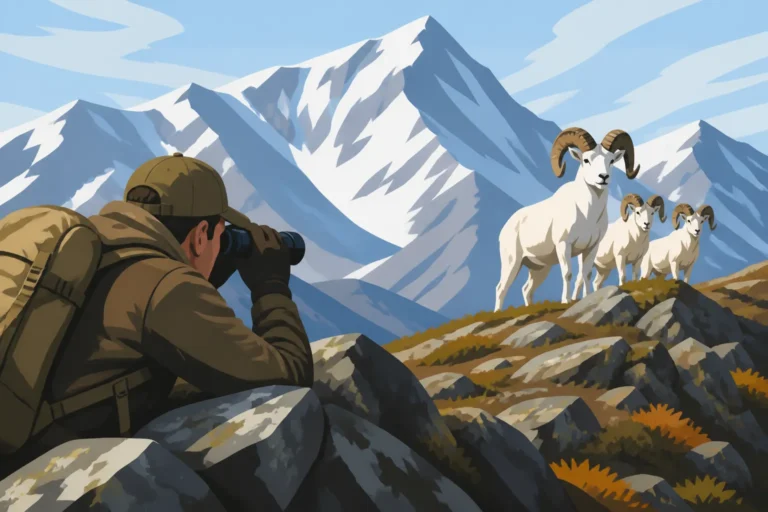
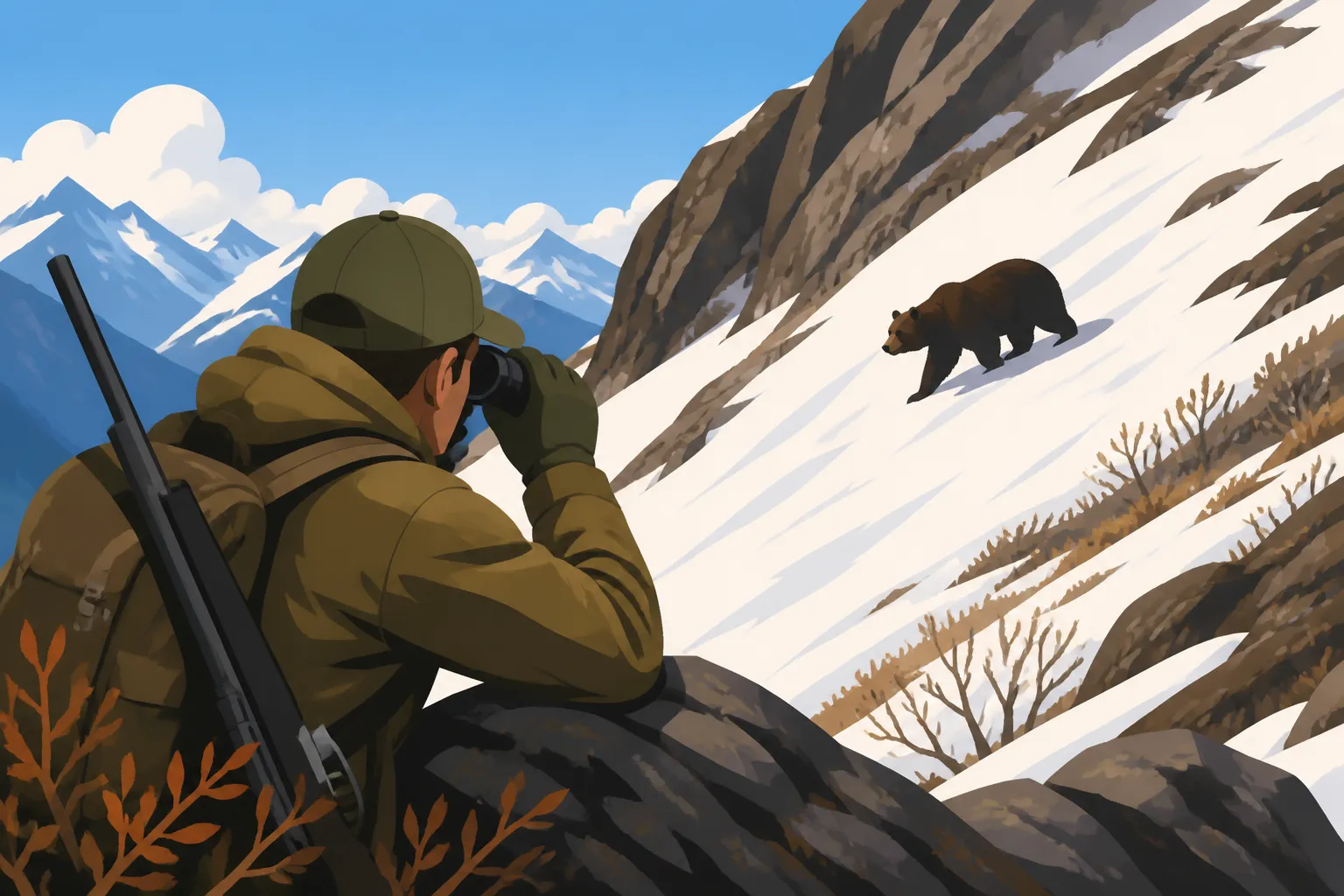
Success on spring bear slides hinges almost entirely on your ability to glass effectively. This means finding a strategic vantage point—a high knob or ridge—that offers a panoramic view of the south-facing slopes you intend to hunt. Set up far enough away that your presence won't disturb any bears, often a mile or more.
Once in position, deploy your best optics: a high-quality spotting scope on a sturdy tripod and a good pair of binoculars. The key is to apply a systematic Glassing Grids That Cover a Whole Basin. Divide the visible terrain into small, manageable grids and meticulously scan each one. Start at the nearest points and slowly work your way out, paying close attention to the interfaces where snow meets bare ground, the edges of timber, and any areas of exposed green-up. Look for anything that breaks the pattern—a dark shape against the snow, a subtle movement, or even just a black lump that might be a bedded bear.
This is not a quick process. Expect to spend hours, even an entire day, methodically glassing. Bears often emerge, feed, and then bed down, sometimes for extended periods. Your patience will be rewarded by spotting a bear that others might overlook. It's often fruitful to glass the same slides multiple times throughout the day, as activity can change dramatically between early morning and late afternoon. This comprehensive approach is much more effective than simply scanning briefly. Consider the effectiveness of Glassing at First Light Versus Midday as bears shift their activity during different light conditions.
Utilizing Snow for Quiet Approaches
Once you've spotted a bear, the next challenge is the stalk. The presence of snow can be a double-edged sword: it can be noisy and crunchy, or it can provide a silent carpet for your approach. Your ability to read the snow conditions is critical.
- Soft Snow: If the snow is soft and slushy from midday sun, it can cushion your footsteps, allowing for an incredibly quiet approach. Use this to your advantage, moving slowly and deliberately.
- Crusted Snow: If the snow has a hard, icy crust (often in the mornings after a cold night), it can be incredibly noisy. In these conditions, you might need to wait for the sun to soften it, or pick a different approach route that utilizes bare ground, dense timber, or creek beds to mask your sound.
When stalking, use the terrain to your advantage. Ridges, draws, and timber lines can provide excellent cover, allowing you to get within shooting range undetected. Always approach from downwind, as a bear's sense of smell is legendary. Move slowly, pause frequently to re-evaluate the bear's position and behavior, and be ready to take a shot quickly if the opportunity presents itself. Mastering Shooting Positions on Alaska Tundra and Sidehills will be invaluable, as shots on slides can often be steep or require an improvised rest.
Gear Considerations for Spring Bear Hunting
Spring in Alaska is notoriously fickle. You can experience all four seasons in a single day, or even within a few hours. Having the right gear isn't just about comfort; it's about safety and ultimately, success.
Optics and Clothing for Variable Conditions
Your optics are paramount. As discussed, a quality pair of 10×42 or 12×50 binoculars are essential for initial scanning, and a 20-60x spotting scope on a sturdy tripod is non-negotiable for identifying bears at extreme distances and judging their size and legal status. Brands like Maven, Vortex, or Leica offer excellent performance that holds up to Alaska's demands.
For clothing, think layers, layers, layers.
- Base Layers: Moisture-wicking synthetics or merino wool are crucial to manage sweat.
- Mid-Layers: Fleece or puffy insulated jackets (down or synthetic) provide warmth without bulk.
- Outer Shell: A durable, waterproof, and windproof jacket and pants are absolutely essential. You'll likely encounter rain, sleet, or wet snow. Brands like Sitka, KUIU, or even reliable military surplus Gore-Tex work wonders.
- Footwear: Waterproof, insulated hiking boots (e.g., Kenetrek, Schnee's, La Sportiva) are critical for navigating melting snow, mud, and potentially cold stream crossings. Bring gaiters to keep snow and debris out of your boots.
- Accessories: Warm gloves (a thin pair for shooting, a heavy pair for glassing), a warm hat, and a brimmed cap to shield from sun and rain are all vital.
The weather can turn on a dime, so being prepared for everything from warm sun to blizzard conditions will keep you in the field longer and more comfortably.
Rifle and Bear Safety Essentials
Choosing the right rifle for black bear hunting in Alaska involves balancing adequate power with shootability. While black bears aren't the largest game in Alaska, they're still tough animals, and a solid ethical kill shot is paramount.
- Rifle Caliber: Popular choices for black bear include .270 Win, .30-06 Springfield, .300 Win Mag, or 7mm Rem Mag. For those who prefer a little more punch, .338 Win Mag works well, though it's often overkill for black bear specifically. The key is accuracy with your chosen rifle. Use premium bullets designed for deep penetration and expansion, such as Barnes TSX, Nosler AccuBond, or Hornady ELD-X. While it covers different species, the advice in Rifle Calibers for Coastal Brown Bear offers valuable insights into choosing a powerful and accurate firearm capable of handling a variety of hunting scenarios.
- Ammunition: Practice extensively with the exact ammunition you plan to hunt with. Understand its trajectory at various ranges.
- Bear Safety: Even though you're hunting black bears, you are in Alaska, and brown bears (grizzlies) can be present anywhere. Always carry bear spray in an easily accessible holster, and many hunters also carry a large-caliber handgun (.44 Mag, 10mm, or .454 Casull) as a last resort. Know how to use both. When you approach a downed bear or work a kill site, always remain vigilant. It’s crucial to understand the protocols for Bear Safety While Butchering a Kill in Alaska to minimize risks. Make noise, especially if working alone, to alert any other bears in the area to your presence.
Understanding Bear Behavior on Snow Slides
Successfully hunting bears on snow slides isn't just about finding the right slope; it's about understanding when and how they use those slopes. Their daily patterns, especially early in the season, are quite predictable once you know what to look for.
Feeding Patterns and Midday Lulls
Bears emerging from hibernation are driven by an immediate need to feed, but their activity isn't constant throughout the day. Typically, you'll find them most active during the cooler parts of the day, particularly:
- Early Morning: Shortly after sunrise, as the sun begins to warm the slopes, bears will often emerge from their beds to forage. The air is crisp, and they can move around comfortably.
- Late Afternoon/Evening: As the day cools down again and shadows lengthen, bears will have another peak of activity, feeding aggressively before bedding down for the night.
During the midday hours, especially if the sun is intense, bears often become less active. They might find a comfortable spot to bed down, often in a small depression, under a cluster of alders, or simply out in the open, soaking up the sun. They'll spend these hours digesting, resting, and conserving energy. Don't be fooled by this lull; just because you don't see them moving doesn't mean they're not there. This is where patient, methodical glassing becomes even more important. A bear can look like nothing more than a black rock or a patch of shadow to the untrained eye.
Judging Bear Size and Legalities
One of the most challenging aspects of bear hunting, especially in the spring, is accurately judging the size and legality of a bear from a distance. In Alaska, it is almost universally illegal to shoot a sow with cubs, and misidentifying a bear can lead to serious consequences.
- Identifying Sows with Cubs: This is paramount. Look for multiple dark shapes moving together. Cubs are often small, disproportionately leggy, and will typically follow the sow closely. Be extra vigilant. If there's any doubt about the presence of cubs, pass on the bear. Remember, the rule applies even if the cubs are tiny and blend in, so being aware of Sows With Cubs and the Legal Line is essential.
- Judging Size: Assessing a bear's size from a distance can be tricky due to a lack of reference points. Look for key indicators:
- Ear Placement: Larger, older bears often have ears that appear smaller relative to their head size, and they tend to be set wider apart on a broader skull. Younger bears usually have proportionally larger ears that sit closer together. This is often the best indicator, as outlined in Judging Bear Size by Ear Spread.
- Body Proportions: A big boar will have a thick, blocky body, often with a noticeable neck and a swaggering gait. Younger bears are more slender and appear "lanky."
- Sway Back/Pot Belly: Older bears, especially boars, can sometimes develop a slight sway in their back or a prominent pot belly as they fill out after hibernation.
- Movement: Larger bears tend to move more slowly and deliberately, while younger bears might be more playful or skittish.
Always take your time. Watch the bear for as long as possible. If you can, wait until it stands up, turns, or offers a profile view. If you have any doubt about its legality or size, let it walk. There will always be another bear.
Field Care and Packing Out Your Spring Bear
The moment of truth is just the beginning of another crucial phase: field care. Proper handling of your bear after the shot ensures you preserve the meat and, if desired, the hide for a trophy.
Rapid Cooling and Hide Preparation
Spring temperatures, even with snow on the ground, can warm up quickly, especially on those sunny south-facing slopes. Bear meat can spoil surprisingly fast, and a thick hide insulates the carcass, trapping heat.
- Immediate Field Dressing: As soon as the bear is down and you've confirmed it's expired and safe to approach, you need to begin field dressing. Remove the entrails as quickly as possible to allow the body cavity to cool.
- Skinning: For most hunters, a spring bear is primarily a trophy hunt for its hide. If you plan a rug or a life-size mount, you'll need to execute a precise skinning job. For a rug, you'll typically make cuts down the center of the back and along the underside of each leg. For a life-size mount, the hide is often "tubed" or split down the belly to keep the back intact. The most critical part for a taxidermist is to leave plenty of hide for "turning"—this means cutting around the lips, ears, and paws, leaving extra hide attached so the taxidermist can properly turn them inside out for salting and preservation. Referencing Cape Care for a Life-Size Bear Mount provides excellent detail for this critical step, even if your quarry is a black bear instead of a brown bear.
- Cooling the Hide: Once skinned, lay the hide out flat in the coolest, shadiest spot you can find, fur-side down, to allow it to cool rapidly. Do not fold it up until it has completely cooled. If possible, fan it to increase air circulation.
Meat Care and Transport Considerations
While black bear meat is often less sought after than moose or caribou, it's absolutely delicious when handled properly and thoroughly cooked to avoid trichinosis. Alaska law requires the salvage of edible meat, so don't leave it to waste.
- Quartering and Bagging: After skinning, quarter the bear into manageable pieces (two front quarters, two hindquarters, backstraps, tenderloins, and neck meat). Place all edible meat into breathable game bags. High-quality synthetic game bags are superior to cotton bags, as they protect the meat from flies and dirt while allowing it to breathe and cool.
- Cooling the Meat: Even with game bags, the thick muscle masses can hold heat. Hang the meat in a cool, shady, breezy spot. If you can't hang it, spread it out on tarps or branches to allow maximum airflow. Rotate the pieces periodically to ensure even cooling. This process is similar to Meat Care in 50-Degree September Weather, though spring conditions can vary more drastically from freezing nights to warm days.
- Packing Out: Bear meat can be heavy. A good internal or external frame pack is essential. Plan your route carefully, considering the terrain and any remaining snow. Distribute the weight evenly in your pack. If you're hunting with a partner, share the load. A bear can yield a surprising amount of meat and hide, so be prepared for multiple trips or a heavy single load. Ensure you have a plan for getting the meat out of the field and to a processor or cooler as quickly as possible.
| Feature | Importance | Scouting Tool Recommendation | Benefits on South-Facing Snow Slides |
|---|---|---|---|
| Aspect | Crucial for early snowmelt & warmth; dictates bear presence. | Satellite maps (GoHunt, Google Earth) | First to clear, warmest, attracts bears early. |
| Elevation | Bears follow receding snowline; influences forage availability. | Topographic maps | Focuses search to prime elevation bands. |
| Vegetation Type | Bears seek first green-up; grasses, sedges, horsetails. | Satellite maps, field glassing | Identifies primary food sources for hungry bears. |
| Avalanche Chutes | Often clear of snow faster, creating natural travel & feeding corridors. | Satellite maps | Concentrates bear activity in defined areas. |
| Water Sources | Bears need water after hibernation. | Topographic maps, field glassing | Draws bears for drinking and lush forage. |
| Security Cover | Bears need nearby cover (timber, alder) for bedding and escape. | Satellite maps, field glassing | Provides safe havens, increasing bear confidence. |
Disclaimer
Hunting in Alaska involves inherent risks, including but not limited to adverse weather, dangerous wildlife, and remote wilderness conditions. Always prioritize safety, adhere to all Alaska Department of Fish and Game regulations, and obtain proper licenses and tags. The information provided here is for educational purposes and should not replace professional guidance or personal experience.