Rifle Calibers for Coastal Brown Bear
When you’re preparing for a coastal brown bear hunt in Alaska, the sheer scale of the challenge can feel overwhelming. These aren't your average black bears; we're talking about some of the largest land predators on Earth, capable of absorbing an incredible amount of lead and still covering ground with terrifying speed. Choosing the right rifle caliber isn't just about bagging a trophy; it's about ensuring your safety and making a clean, ethical kill on an animal that demands absolute respect. This guide will meticulously break down the ballistic considerations and effective calibers to help you make this critical decision.
The Formidable Power of Alaska's Coastal Brown Bears
Let's be brutally honest: hunting a coastal brown bear is not for the faint of heart, nor for the under-gunned. These are animals of immense power, surprising speed, and incredible tenacity. Many hunters arrive in Alaska with a solid understanding of big game hunting, but the reality of a truly large brown bear can be a humbling, even terrifying, experience. The coastal regions, particularly the Alaska Peninsula and Kodiak Island, are renowned for producing some of the largest bears in the world. Their size is often attributed to the rich salmon runs and abundant protein sources, leading to bears that can easily weigh over 1,000 pounds and stand over ten feet tall on their hind legs. If you want to dive deeper into why these coastal giants are so imposing, you can explore information on What Makes Alaska Peninsula Bears So Large.
The primary frustration many hunters face is the inherent "what if" factor. What if the bear charges? What if my first shot isn't perfect? This isn't theoretical; brown bear charges happen. When you're facing down an animal that can close 50 yards in a few seconds, you need confidence in your equipment and your ability to use it. The sheer musculature and bone structure of these bears demand a bullet that can penetrate deeply and deliver a devastating amount of energy to vital organs or the central nervous system. Anything less risks a wounded animal, a dangerous situation for the hunter, and a potentially lost trophy. The difference between Alaska Brown Bears on the Coast Versus Interior Grizzlies is significant when it comes to average size and density, making coastal hunts particularly demanding.
Even when things go perfectly, the physical and psychological toll of a brown bear hunt is immense. You might be glassing for hours, maybe even days, looking for that one legal boar. When the moment finally comes, your heart will pound, adrenaline will surge, and you need to be able to execute a precise shot with a powerful rifle. This isn't just about hunting; it's about a raw, primal confrontation that tests your mettle and your gear to its absolute limits.
Understanding Ballistics for Bear Country Confidence
When we talk about rifle calibers for coastal brown bear, we're not just discussing how big the hole is. We're delving into the physics of terminal ballistics—how a bullet performs when it hits an animal. This is where scientific understanding meets real-world application, and where armchair theories often fall apart when confronted by thick hide, heavy bone, and sheer mass.
Kinetic Energy and Momentum Explained
Most hunters are familiar with kinetic energy (KE), often measured in foot-pounds (ft-lbs). While high KE is good, it's not the only factor. Momentum (mass x velocity) is equally, if not more, critical for deep penetration on heavy-bodied animals like brown bears. Imagine the difference between throwing a ping-pong ball fast versus a bowling ball slowly; the bowling ball, despite its lower velocity, has significantly more momentum and will push through obstacles. For brown bears, you need a bullet that can punch through layers of fat, muscle, and bone to reach the vitals. This isn't a game for light, fast bullets designed for varmints or deer. You're looking for heavy-for-caliber projectiles that retain their mass and velocity through tough resistance. Many serious hunters consult ballistic charts, often found through resources like GoHunt, to meticulously compare different loads and bullet weights for optimal performance against such formidable game.
A rifle round like the .338 Winchester Magnum, for example, delivers substantial kinetic energy and momentum. Stepping up to a .375 H&H Magnum or even a .416 Rigby brings even more to the table, and that extra margin of power can be invaluable when things go sideways or when you need to break through a shoulder. It’s about ensuring that the bullet doesn’t just scratch the surface but pushes deep, disrupting critical systems.
The Role of Bullet Construction
Perhaps even more important than the caliber itself is the bullet's construction. A poorly constructed bullet, regardless of caliber, will fail. We're talking about controlled expansion here—bullets that hold together, expand reliably, and retain as much weight as possible as they bore through tissue.
Cheap, rapidly expanding hunting bullets designed for deer or elk will fragment or flatten prematurely on a brown bear's heavy bone structure, failing to reach the vitals. What you need are premium, heavy-duty bullets designed for dangerous game. Think bonded core designs (where the lead core is molecularly bonded to the copper jacket to prevent separation), partition designs (like the Nosler Partition, which has two lead cores separated by a jacket partition), or monolithic solid copper bullets (like the Barnes TSX or TTSX, which expand reliably without losing weight). Brands like Swift A-Frame and Hornady Dangerous Game series are also trusted by many. When discussing Rifle Choice for Alaska Brown Bear Country, bullet construction is often highlighted as a critical component, not just the caliber. These bullets are engineered to penetrate deeply and consistently, even when encountering dense bone, ensuring maximum energy transfer where it counts.
Top Caliber Recommendations for Coastal Brown Bear
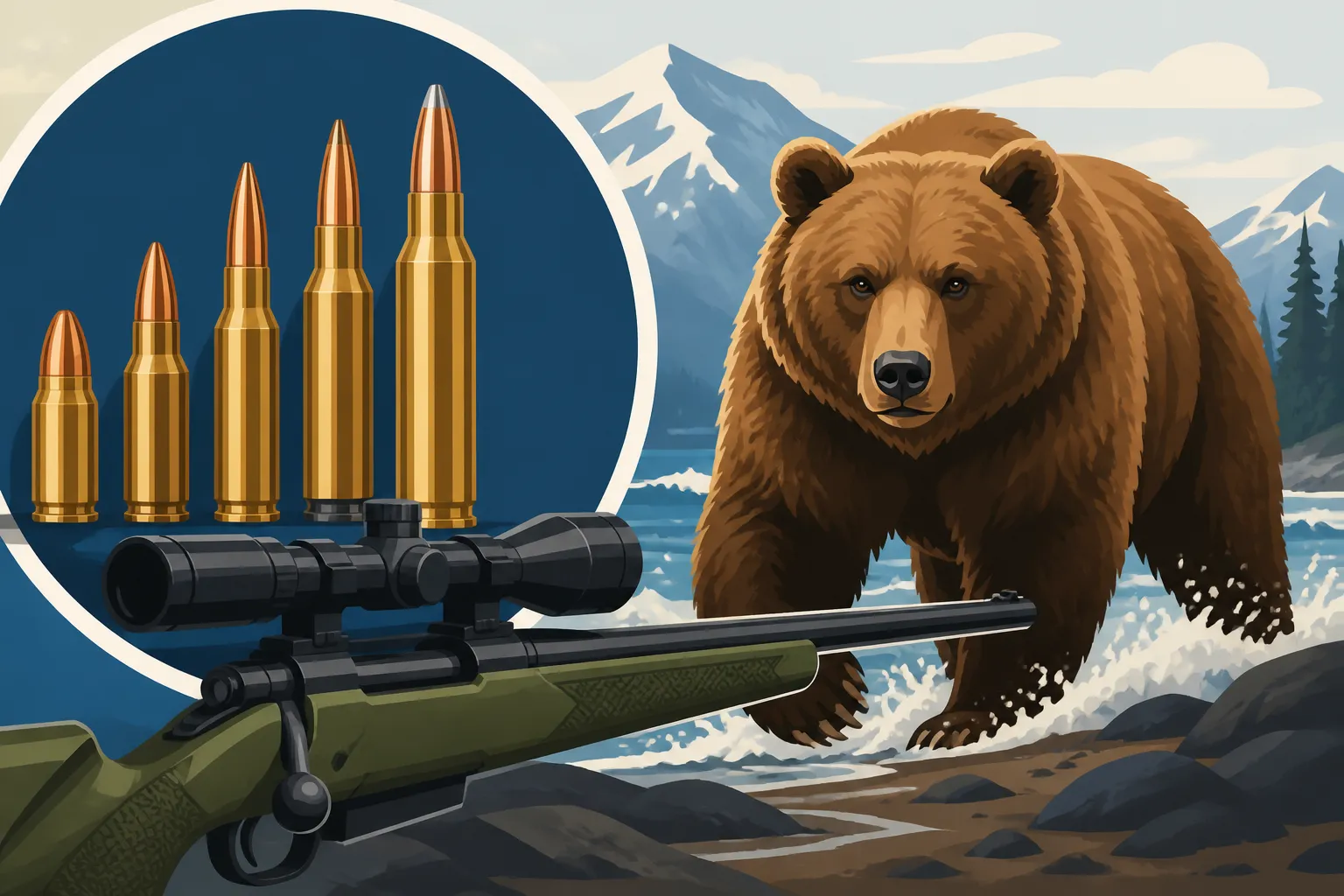
Now, let's talk brass tacks. While there are a handful of cartridges that can take a brown bear, there's a smaller selection that are truly recommended for their stopping power, penetration capabilities, and generally manageable recoil (relative to their power, of course). The key is finding that balance between what delivers sufficient punch and what you can shoot accurately under stress.
The .338 Winchester Magnum
The .338 Win Mag is often considered the minimum entry point for coastal brown bear, and for good reason. It delivers significantly more power than standard magnum rifle cartridges like the .300 Win Mag. It's a widely available cartridge with a diverse selection of premium bullets, typically in the 225-grain to 275-grain range.
Many hunters find the recoil of the .338 Win Mag stout but manageable with practice, making it a viable option for those who might struggle with heavier-recoiling cartridges. With a well-constructed 250-grain bullet (like a Nosler Partition or Barnes TSX), it can achieve excellent penetration and put down even the largest bears. Its flatter trajectory compared to some larger bore options also makes it a solid choice for slightly longer shots that might present themselves on the open tundra or mountainsides. It’s a workhorse for Alaska, capable of handling everything from moose to elk with proper bullet selection. However, as with any caliber, proper Sighting In a Rifle After a Bush Flight is crucial to ensure accuracy.
The .375 H&H Magnum
If there's a classic, go-to dangerous game cartridge, it's the .375 H&H Magnum. Developed over a century ago, it remains one of the most reliable and respected big-bore cartridges for serious hunting worldwide. It offers a significant step up in power and bullet weight compared to the .338 Win Mag, typically pushing 270-grain to 300-grain bullets.
The .375 H&H Mag has a reputation for being inherently accurate and, surprisingly, for its relatively "pushy" recoil rather than a sharp jab, making it more tolerable for many shooters than cartridges with similar power. Its heavy, large-diameter bullets create a wider wound channel and offer superior penetration, making it an excellent choice for broadside shots on vitals and as a backup in a charge scenario. Many experienced guides in Alaska carry a .375 H&H, or similar, as their primary backup rifle, speaking volumes about its trusted performance. When budgeting for your hunt, it's important to remember that What an Alaska Guided Brown Bear Hunt Costs will include the peace of mind of having a capable rifle.
The .416 Caliber Options: Remington Magnum & Rigby
For those who want to step up the power even further, the .416 Remington Magnum and .416 Rigby offer substantial increases in stopping power. These cartridges typically propel 400-grain bullets at impressive velocities, delivering truly authoritative performance. The .416 Rem Mag often matches or exceeds the ballistics of the classic .416 Rigby, but does so in a standard magnum-length action. The .416 Rigby, on the other hand, operates at lower pressures, which is a benefit in extreme cold, and has a legendary history.
These calibers are for serious hunters who are well-versed in managing heavy recoil. They are not for the faint of shoulder, and extensive practice is absolutely essential. The reward, however, is an undeniable increase in raw stopping power and penetration. If you are hiring a guide, they will often have specific Rifle Requirements on an Alaska Guided Bear Hunt, and these calibers will undoubtedly meet those criteria.
The .458 Winchester Magnum and Beyond
For those who demand the utmost in stopping power, cartridges like the .458 Winchester Magnum and its big brother, the .458 Lott, are the ultimate choices. Launching 500-grain bullets with bone-crushing energy, these are specialized dangerous game rounds.
Recoil from these cartridges is severe and requires significant training and conditioning to shoot accurately and repeatedly. They are generally considered overkill for most brown bear hunting situations where careful shot placement is possible, but for close-range defense or exceptionally heavy game, they offer an unparalleled level of confidence. However, unless you are genuinely comfortable and proficient with such heavy recoil, it's often better to stick with a caliber you can shoot well, rather than one that makes you flinch.
Here’s a quick comparison of some popular calibers for brown bear hunting:
| Caliber | Typical Bullet Weight (grains) | Muzzle Energy (ft-lbs) | Advantages | Considerations |
|---|---|---|---|---|
| .338 Winchester Mag | 225-275 | 3,800 – 4,500 | Widely available, good balance of power/recoil. | Minimum for coastal bear, requires premium bullets. |
| .375 H&H Magnum | 270-300 | 4,000 – 4,800 | Classic, reliable, manageable "pushy" recoil. | Good all-around, a solid step up in power. |
| .416 Remington Mag | 400 | 5,000 – 5,500 | Excellent stopping power, heavy penetration. | Significant recoil, requires practice. |
| .458 Winchester Mag | 500 | 5,500 – 6,000+ | Maximum stopping power, extreme penetration. | Very heavy recoil, specialized use. |
Note: Muzzle energy figures are approximate and vary based on specific load data and barrel length.
Beyond Caliber: Bullet Selection, Shot Placement, and Practice
While choosing the right caliber is paramount, it's only one part of the equation. Many experienced hunters will tell you that a well-placed shot with a quality bullet from a "smaller" adequate caliber is infinitely better than a poorly placed shot from the largest magnum available.
The Unwavering Importance of Bullet Selection
As discussed earlier, your choice of bullet is critical. Do not skimp here. Spend the extra money on premium, heavy-for-caliber bullets designed for dangerous game. Whether it’s a Barnes TSX, Nosler Partition, Swift A-Frame, or another reputable dangerous game bullet, ensure it's built to penetrate deeply and retain its integrity. These bullets are designed to expand in a controlled manner, creating a devastating wound channel without fragmenting, ensuring that critical organs are reached. Bullet performance is non-negotiable insurance in a brown bear encounter.
Precision Through Practice and Shot Placement
This is where the rubber meets the road. Even the most powerful rifle is useless if you can't hit your target accurately under duress. Coastal brown bear hunting demands precision. You must know your rifle intimately, practice shooting it from various field positions, and, crucially, understand how to manage recoil effectively. Flinching or anticipating recoil will lead to poor shots, and a poor shot on a brown bear can have severe consequences. If you want to know more about different firing positions, you could read up on Shooting Positions on Alaska Tundra and Sidehills.
Target the bear's vital zone: the lungs and heart. On a broadside shot, this is typically behind the shoulder, slightly forward and low. If the bear is facing you, a shot to the chest aiming for the central nervous system (brain or spine) or heart is paramount, but this is a much smaller, riskier target. Always aim to put a bullet through both lungs and, ideally, the heart. If you face a charging bear, your target shifts to its head or shoulders to break it down quickly. This is where the power of a larger caliber combined with a fast, accurate follow-up shot can be lifesaving. The discussion of Bear Spray Versus Rifle at Close Range often highlights the immediate and devastating need for stopping power.
Preparing for the Unpredictable
No matter how prepared you are, Alaska's wilderness can always throw a curveball. Weather changes instantly, terrain is unforgiving, and bears are unpredictable. That's why your gear, including your rifle, needs to be utterly reliable. When you're dealing with Working a Kill Site in Grizzly Country, you need to be prepared for more bears.
Think about the conditions. Will your rifle function reliably in cold rain? Can you cycle the action quickly with cold hands? Have you practiced reloading under pressure? These are the practical considerations that often get overlooked in favor of ballistic tables. The confidence that comes from extensive practice with your chosen caliber and bullet combination is priceless. Planning for contingencies, like Emergency Evacuation Plans in Remote Alaska, is also a crucial part of your overall preparation.
Ultimately, the best rifle caliber for your coastal brown bear hunt is the one you can shoot accurately, consistently, and confidently, loaded with the best premium bullets you can find. It’s a holistic decision that blends ballistic performance with your personal shooting abilities and preparation.
Disclaimer
Hunting in Alaska carries inherent risks, including serious injury or death. The information provided in this article is for educational purposes only and should not be considered a substitute for professional guidance, thorough research of current regulations, or proper safety training. Always prioritize safety, respect wildlife, and comply with all Alaska Department of Fish and Game regulations.