Bear Safety While Butchering a Kill in Alaska
Butchering a big game animal in the Alaskan wilderness is a monumental task, and the last thing you want is a surprise visit from a bear. That heart-pounding fear of being caught unprepared, or worse, losing your hard-earned meat, is a very real concern for every hunter. This guide dives deep into practical, real-world strategies for staying safe, deterring curious bruins, and defending yourself while you're focused on processing your kill.
Understanding the Risk: Why Bears Are Drawn to Kill Sites
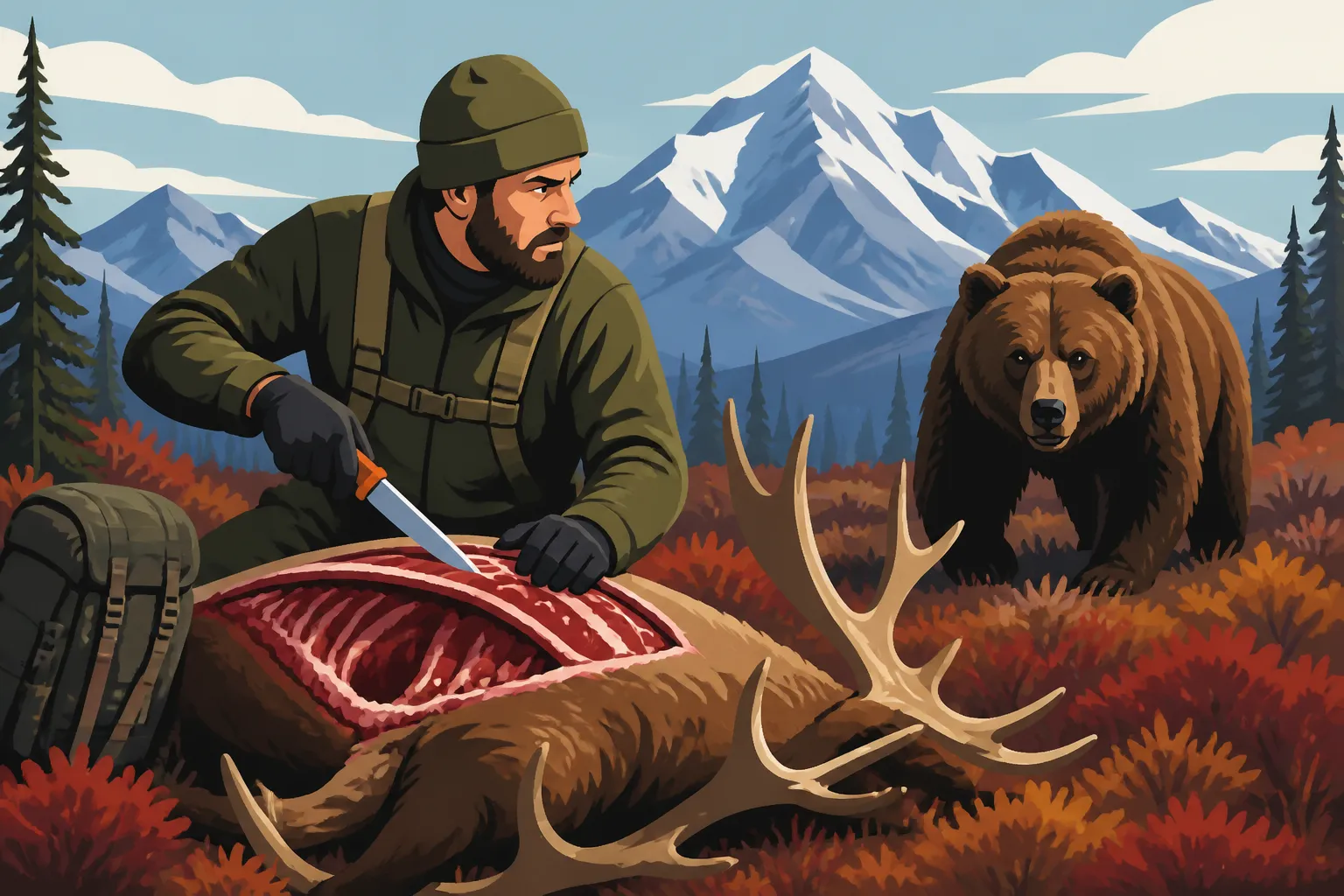
Let's face it, when you've finally got a big moose or caribou on the ground after days of hard hunting, your focus is entirely on the monumental task ahead: getting that meat processed and secured. But this is precisely when you become most vulnerable. You're physically exerted, mentally drained, and knee-deep in a process that generates a potent beacon for every bear within sniffing distance. The idea that a bear won't find your kill site is often just wishful thinking in a place like Alaska. They're wired to find these opportunities, and they will.
The frustration of having your hard-won animal potentially compromised by a bear is a deeply felt concern for many hunters. It’s not just about safety; it’s about the respect for the animal and the effort you’ve put in. Ignoring the very real possibility of a bear encounter at a kill site isn't just naive; it's dangerous. Understanding why they come and what kind of bears you might face is the first crucial step in developing an effective safety plan.
The Irresistible Scent of Fresh Meat
There's no sugarcoating it: a fresh kill site is an olfactory billboard in the wilderness, broadcasting a clear message to bears: "Dinner is served!" The moment you make a kill, especially a large animal like a moose, the air fills with an incredible array of scents that travel surprisingly far. Blood, entrails, and the sheer volume of raw meat create an almost irresistible attractant that bears are exceptionally well-equipped to detect. Their sense of smell is legendary, far surpassing that of a bloodhound, and they use it constantly to locate food sources.
Even in areas where bear numbers aren't exceptionally high, one passing by could pick up the scent cone from your kill site miles away and decide to investigate. The wind currents carry these smells through valleys, over ridges, and across vast stretches of tundra, acting like an invisible highway leading straight to your location. This isn't just a hypothesis; it's a fundamental biological reality of bear behavior. You simply cannot eliminate the scent, only manage its impact.
Types of Bears You'll Encounter in Alaska
Alaska is home to both brown bears (which include grizzlies) and black bears, and understanding the differences in their behavior, particularly around kill sites, is critical. While both are dangerous, their typical reactions and threat levels can vary. Brown bears, especially coastal brown bears on the Alaska Peninsula or Kodiak Island, are often larger, more territorial, and more prone to assert dominance over a food source. They see a kill as a potential meal they're entitled to.
Interior grizzlies, while smaller than their coastal cousins, are still powerful and can be extremely aggressive when defending a carcass. Black bears are generally more timid and might be deterred more easily, but never underestimate a black bear, especially a hungry one or a sow with cubs. A common misconception is that black bears are "safe." They are wild animals with claws and teeth, and any bear protecting a food source or cubs can become lethal. Knowing your hunting unit and the predominant bear species, perhaps by using mapping tools like those offered by GoHunt to research local game populations, can give you a heads-up on what to expect.
Bear Behavior Around Carcasses
When a bear finds a carcass, their behavior isn't always predictable, which is what makes these encounters so unsettling. Some bears might circle cautiously, testing the waters, while others might approach directly, boldly asserting their claim. Often, a bear might "cache" a kill – covering it with dirt, leaves, or branches – intending to return to it later. This behavior is particularly prevalent with brown bears and indicates a strong proprietary interest. If you stumble upon a cached carcass, assume the bear is nearby and prepared to defend it.
Bears that are habituated to humans, perhaps from previous encounters with careless campers or hunters, might be less fearful. Those that are particularly food-stressed, or sows protecting cubs, can exhibit extreme aggression. The key takeaway here is that any bear around a carcass should be treated as a potentially aggressive and unpredictable animal. They aren't just curious; they view that carcass as theirs, and you, in their eyes, are a competitor. This possessive instinct is Why Alaska Bans Baiting for Brown Bears is a critical regulation – it prevents bears from associating humans directly with easy meals and reinforces their natural foraging behaviors, hopefully keeping them more wary of us.
Essential Gear and Preparation for Bear Encounters
Stepping into the Alaskan wilderness without proper bear safety gear and a well-thought-out plan is akin to driving a car without brakes—it's just a matter of time before something goes wrong. The best defense is proactive preparation. You can't just hope for the best; you have to plan for the worst. This means having the right tools on your person and being intimately familiar with how to use them, not just in theory, but under immense stress.
Many hunters feel a mix of confidence and apprehension when thinking about bear defense. You've trained with your rifle, but what about when a bear charges? The thought of having to use lethal force is daunting, but being unprepared is far more terrifying. This section isn't about fear-mongering; it's about empowering you with the knowledge and tools to confidently manage a potentially life-threatening situation.
Firearms and Ammunition for Bear Defense
When it comes to firearms for bear defense at a kill site, there's a strong consensus: carry something substantial and know how to use it proficiently. We're talking about reliable, large-caliber rifles, shotguns, or handguns that can deliver significant kinetic energy. For rifles, common choices often include .338 Win Mag, .375 H&H, or even a heavy .30-06 with stout bullets. A 12-gauge shotgun loaded with slugs is also a formidable option.
The key isn't just the caliber, but your ability to deploy it quickly and accurately under duress. This means carrying it in a manner that allows for immediate access, not slung over your shoulder out of reach. Practice quick target acquisition and firing from various positions. For handguns, a large-caliber revolver like a .44 Magnum or .454 Casull is often favored for its reliability and stopping power. Remember that Rifle Choice for Alaska Brown Bear Country, and really any bear country, should prioritize penetration and knockdown power over flat trajectory. Always use hard-cast or bonded bullets designed for deep penetration on heavy bone and muscle, not expanding varmint rounds.
Bear Spray: Your First Line of Defense
Bear spray is often your first, non-lethal line of defense, and frankly, it's incredibly effective when deployed correctly. It's a powerful capsaicin-based deterrent designed to temporarily incapacitate a bear, allowing you time to retreat. Crucially, bear spray is not a substitute for a firearm; it's a complementary tool. The biggest mistake hunters make is carrying it deep in a pack. It needs to be immediately accessible, clipped to a hip belt or chest harness.
Knowing how to use it is paramount. You need to pull the safety tab, aim for the bear's face (eyes and nose), and deploy a continuous cloud, not just a quick squirt. Pay attention to wind direction, as spraying into a headwind will quickly turn you into the target of the spray. Bear spray typically has a range of 20-30 feet, so you need to let the bear get close enough for it to be effective. It provides a much wider margin of error than a firearm and, importantly, doesn't require you to make a lethal decision unless absolutely necessary. Many seasoned Alaskans carry both, recognizing that Bear Spray Versus Rifle at Close Range offers different advantages depending on the situation.
Communication and Signal Devices
In remote Alaska, cell service is a rare luxury, which means you need reliable backup communication. This is especially true when you're deeply engrossed in butchering, potentially out of earshot or sight of a partner, or if an incident occurs. A satellite messenger like an InReach or Zoleo, or a satellite phone, is indispensable. These devices allow you to send SOS signals, track your location, and communicate with loved ones or emergency services.
Beyond electronic devices, traditional signal methods still hold value. A loud whistle, a signaling mirror, or even a firearm discharge (three shots in quick succession is a universal distress signal) can alert a hunting partner or call for help if you're within range. Before heading out, establish clear communication protocols and check-in schedules with your hunting party and a contact back home, especially for solo trips. Referencing a guide on Signal Devices and Check-In Plans for Solo Alaska Hunts can provide even more detailed strategies for staying connected. These devices aren't just for emergencies; they offer peace of mind, knowing that if a bear encounter goes sideways, you have a way to reach out.
Setting Up a Secure Butchering Site
So, you've got your animal down, and now the real work begins. This is not the time to rush or be sloppy with your site selection. The location and setup of your butchering site are just as critical to bear safety as the gear you carry. A poorly chosen spot can turn a manageable situation into a high-stress nightmare. The sheer volume of work involved in processing a large animal, like a bull moose, means you'll be at the site for hours, possibly even overnight, and bears know this.
The pressure to get meat quartered and cooled, especially in warm September weather, can be immense. But sacrificing safety for speed is a gamble you don't want to take in bear country. Many hunters feel this pull—the clock ticking, the flies buzzing—but taking an extra 15-30 minutes to set up correctly can literally save your life. This means deliberately creating a workspace that gives you every possible advantage against an approaching bear.
Site Selection: Visibility and Escape Routes
When choosing where to butcher your kill, think like a bear, then think like a soldier. First, consider visibility. You want an open area with good sightlines in all directions, free from dense brush or tall timber where a bear could approach undetected. Avoid thick willow patches, dense spruce forests, or deep ravines that could offer a bear concealment until it’s too late. If you must work in an area with limited visibility, assign a dedicated lookout.
Second, always have an escape route in mind—or multiple. This isn't about running from a bear, but having a clear path to a defensible position or to quickly gain distance if a bear charges. Avoid working in a dead-end ravine or against a cliff face where you could be cornered. Look for a large, sturdy tree to climb (if you're physically capable and it's a black bear situation) or an open area where you can use your deterrents effectively. A quick scan of the terrain, perhaps pre-scouted with satellite imagery or mapping tools from GoHunt, can reveal these critical details before you even touch the hide.
Creating a Perimeter and Scent Control
Establishing a perimeter around your butchering site is a proactive measure that can make a huge difference. Think of it as your early warning system. Ideally, you want to create a mental and physical boundary that gives you time to react. This could involve placing game bags or gear strategically, creating a small clearing, or even hanging strips of flagging tape (though bears don't care about flagging, it helps you maintain awareness of your zone). The key is to consciously divide your "work zone" from the "danger zone" outside.
Scent control, while impossible to fully achieve, can be managed. The guts and primary blood pool are the most potent attractants. Whenever possible, drag the gut pile away from your butchering site and camp, downhill and downwind if feasible. Don't leave blood-soaked clothing or gear lying around. Pack out all non-meat waste, including trash, and double-bag anything with a strong scent. When you're quartering a large animal, like in Quartering a Bull Moose Alone in the Field, managing this waste becomes even more crucial to reduce the overall attractant. Remember, every little bit of scent mitigation helps diminish the intensity of that "dinner bell" you're ringing.
Working in Teams: The Buddy System
If there’s one golden rule for bear country, it’s this: never work alone at a kill site. The buddy system isn't just a good idea; it's a life-saving protocol. While one person is actively butchering, the other should be on constant lookout, weapon ready, scanning the perimeter, and listening for any sounds of approach. This division of labor allows one person to maintain awareness while the other focuses on the intricate, demanding work of processing the animal.
Rotate lookout duties to prevent fatigue and ensure fresh eyes are always on the surroundings. Discuss pre-determined signals for bear sightings—a quiet whistle for a distant bear, a shout for a close encounter. If you're lucky enough to have a third person, one can focus on butchering, one on lookout, and the third on meat packing and cache setup. This layered approach significantly increases your chances of early detection and effective defense. Even the most experienced solo hunters will admit the added anxiety of managing a kill site alone in grizzly country.
Strategies for Deterring and Defending Against Bears
Despite your best preparations, a bear might still decide to investigate your kill site. When that happens, your reaction in those critical first moments can dictate the outcome. It's a high-stakes situation where hesitation or incorrect action can have dire consequences. The feeling of adrenaline surging as you spot a bear, knowing it's coming for what you've worked so hard for, is something every Alaska hunter understands.
The crucial part is moving beyond that initial shock and acting decisively. You have tools and strategies at your disposal, but they only work if you employ them correctly and with confidence. This isn't about picking a fight; it's about establishing boundaries and making it clear, non-negotiably, that this kill site is not open for public access, at least not while you're there.
Noise and Presence: Making Your Presence Known
The absolute first thing you should do when you detect a bear is to make your presence known, loudly and clearly. Many bear encounters escalate because the bear is surprised by your presence. Yell, clap your hands, bang pots and pans, or use an air horn. The goal is to establish that you are human, you are present, and you are not prey. Often, a bear, particularly a black bear or a less habituated grizzly, will retreat if it knows humans are there.
Simultaneously, make yourself look as large as possible. Stand tall, spread your arms, and group up with your hunting partners. Do not run. Running can trigger a chase response in a bear. While making noise, position yourself between the bear and the carcass, if safe to do so. Your aim is to deter, not provoke. The initial shock of human presence is often enough to send a cautious bear on its way. This proactive and assertive stance is a key component of Working a Kill Site in Grizzly Country.
Using Bear Spray Effectively
If a bear continues to approach or exhibits aggressive behavior, bear spray is your next tool. As discussed, it must be instantly accessible. Remove the safety clip and be ready to deploy. Wait until the bear is within effective range, typically 20-30 feet, before deploying. Aim for the bear's face and spray a continuous cloud, moving with the bear if it attempts to circle. The goal is to create a pungent, irritating cloud that the bear must walk through.
Once deployed, if the bear is disoriented, back away slowly while still facing the bear. Do not turn your back and run. Continue to make noise. The spray is designed to buy you time and space. Remember that wind can affect the spray's effectiveness, so be mindful of its direction. While terrifying, staying calm and deploying the spray correctly is your best chance for a non-lethal resolution.
When to Use a Firearm
Using a firearm for bear defense is the last resort, reserved for situations where your life, or the life of a hunting partner, is in immediate danger. This includes a full-blown charge, a bear attacking, or a bear that cannot be deterred by other means and is showing overt aggression. The decision to draw and fire your weapon is monumental and must be made with absolute certainty that there is no other option.
If you must use your firearm, aim for the central nervous system (head or spine) to stop the bear instantly. However, these are incredibly difficult targets on a charging animal. The more realistic target for stopping power is the front shoulder or chest, aiming to break bones and damage vital organs to quickly incapacitate it. Continuously fire until the threat is absolutely neutralized. The goal is to stop the charge, not just wound the animal. This is where your practice with a heavy-hitting caliber, as discussed in Carrying a Sidearm Around a Kill Site, truly pays off. Be prepared for rapid, accurate follow-up shots.
Post-Butchering Cleanup and Camp Protocols
You’ve successfully quartered your animal, perhaps even driven off a curious bear. The hard work isn’t over yet. How you manage the kill site and your camp after the butchering process is just as important for ongoing bear safety. Neglecting proper cleanup can turn your camp into a lingering attractant, inviting return visits from bears, potentially even more persistent ones. The exhaustion after butchering can tempt you to cut corners, but this is exactly when vigilance is most needed.
Many hunters feel a sense of relief once the meat is secured, and that’s natural. But that relief shouldn't translate into complacency. Bears have excellent memories and will revisit locations where they've found food. Ensuring your meat is safe and your camp remains unappealing to bears is a continuous effort that extends long after the last quarter has been packed out.
Proper Meat Storage and Cache Setup
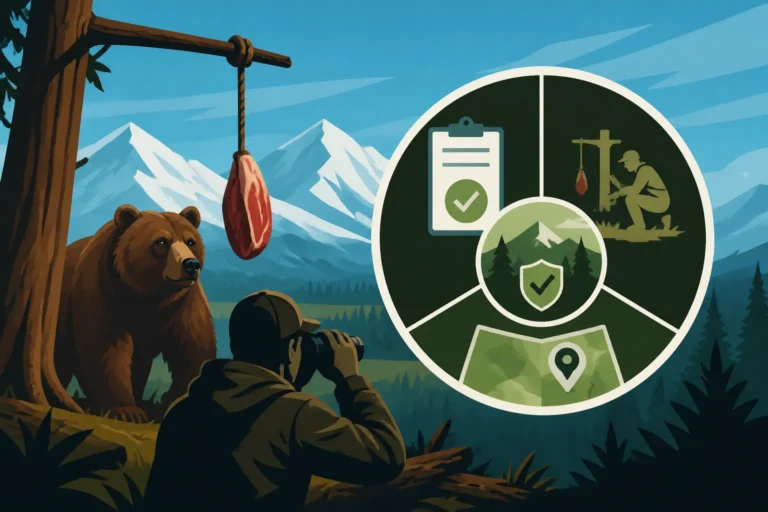
Once you’ve got your game in bags, it’s critical to store it properly. In Alaska, this usually means getting it off the ground and away from your sleeping area. The ideal scenario is to hang meat out of bear reach, often 10-12 feet high and at least 4 feet from any tree trunk, using a pulley system or a robust natural branch. If no suitable trees are available, constructing a meat pole or platform is necessary. Make sure your game bags are breathable, like those recommended in Game Bags That Breathe in Coastal Rain, to allow the meat to cool while protecting it from flies and birds.
If hanging isn isn't feasible, especially for very heavy quarters like moose, a meat cache on the ground, properly fenced, is your next best option. This means using an electric bear fence, which is highly effective when set up correctly. For detailed instructions, refer to Bear Fence Setup at a Meat Cache. Never leave meat unwrapped or unsecured on the ground. The lingering scent alone is an invitation, but easy access is an irresistible incentive for bears to raid your cache. The sooner you get the meat cooled, the better, especially when Hanging Meat in Warm September Weather.
Waste Disposal and Scent Mitigation
This is where a lot of hunters make mistakes. You’ve got bones, hide, and entrails left over, and they are potent bear attractants. The best practice for waste disposal is to spread the gut pile and carcass remains over as wide an area as possible, away from your camp and away from game trails. The more dispersed the scent, the less concentrated and identifiable it is as a single, large food source. If possible, choose a location downhill and downwind from your camp.
Don't just pile everything in one spot close by. The goal is to make it less appealing for a bear to sit and feed on for an extended period, encouraging them to forage rather than camp out. Burn any disposable trash, if allowed and safe, or pack it out in heavy-duty, odor-proof bags. Wash blood off hands, tools, and clothing immediately, or at least change into clean clothes for camp. The less your camp smells like a butcher shop, the safer you'll be.
Maintaining a Clean Camp
A clean camp is a safe camp. This extends beyond just food and meat. Any item with an appealing scent, from toothpaste and deodorant to cooking fuel and dirty dishes, needs to be stored securely. Ideally, all food, scented items, and cooking gear should be hung from a bear pole, stored in a bear-resistant container, or kept inside an electric bear fence, well away from your sleeping tents.
Never cook or eat inside your tent. Designate a cooking area well away from your sleeping quarters and clean up thoroughly after every meal. Pack out all food scraps and trash. Even a seemingly insignificant wrapper can be a strong attractant to a bear. Regularly check your perimeter and be mindful of unusual smells or signs of bear activity, like fresh tracks or scat. Consistent vigilance, and treating every piece of scented gear as a potential attractant, will significantly reduce your risk of an unwanted midnight visitor. You might even find it useful to consult resources like GoHunt for planning and tracking your camp locations, allowing for better strategic placement relative to kill sites and potential bear activity.
Disclaimer
The information provided in this guide is for informational purposes only and is not a substitute for professional instruction, local regulations, or common sense. Hunting in Alaska carries inherent risks, and bear encounters can be dangerous and unpredictable. Always follow all Alaska Department of Fish and Game regulations, secure appropriate licenses and tags, and prioritize safety above all else. Proper training in firearm use and bear spray deployment is essential.