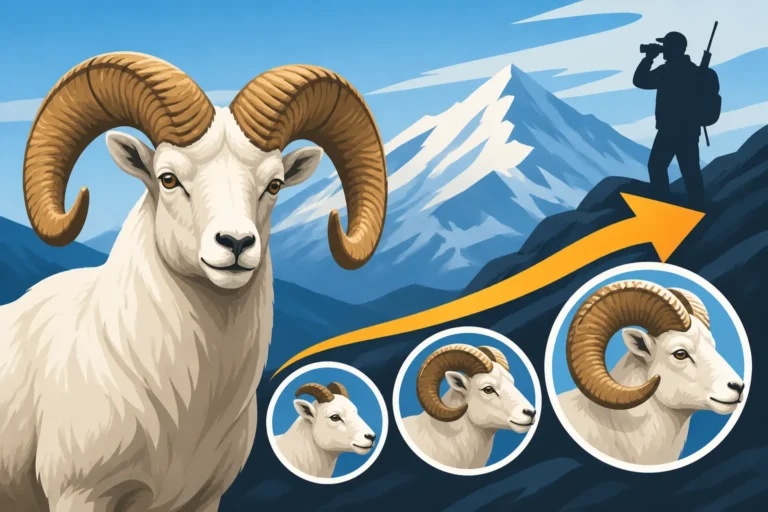
Ram Groups Versus Ewe Bands
One of the most common dilemmas faced by anyone peering through a spotting scope in Alaska's rugged mountains is accurately identifying the white specs scattered across a distant slope. Mistaking a group of ewes for legal rams, or spending precious time stalking a non-legal animal, is a frustration many of us have faced. This comprehensive guide will help you understand the fundamental differences between Dall sheep ram groups and ewe bands, equipping you with the knowledge to make confident identifications in the challenging Alaskan backcountry.
Understanding the Social Dynamics of Dall Sheep
Dall sheep, like many wild sheep species, exhibit distinct social structures that greatly influence their grouping patterns. This isn't just a biological curiosity; it's a critical piece of information for hunters trying to locate and identify target animals. Knowing how these groups typically form and behave can save you countless hours of hiking or second-guessing in the field. The vastness of the Alaska Range and the Brooks Range makes efficient glassing and correct identification paramount.
Segregation by Sex and Age
Dall sheep society is largely segregated by sex and age, especially outside of the breeding season. This natural separation is a survival mechanism, allowing different demographics to thrive in specific habitats and avoid competition for resources during critical periods. Young rams typically stay with ewe bands for a few years, but once they start developing significant horn growth, they'll often venture off to join bachelor groups.
As a hunter, recognizing this segregation is your first clue. If you spot a large group that appears to be entirely made up of smaller-bodied sheep with small horns, you're almost certainly looking at an ewe band. Conversely, a group of larger-bodied sheep, all sporting impressive headgear, is a strong indicator of a ram group. There might be some overlap, particularly with younger rams, but the general rule holds true and is immensely helpful when you're trying to quickly assess a distant hillside.
Seasonal Grouping Patterns
While the segregation is generally consistent, the exact composition and location of ram and ewe groups can shift with the seasons. During the summer and early fall, before the rut kicks in, rams typically reside at higher elevations, often in rougher terrain, focusing on feeding and horn growth. Ewe bands, with their lambs and yearlings, often prefer slightly more accessible, albeit still steep, terrain where forage might be richer and escape routes more numerous.
As fall progresses into the rut (typically late October through November), this segregation breaks down as rams descend to join the ewe bands for breeding. However, most hunting seasons for Dall sheep conclude before this intense rutting period. Therefore, during the August and September hunting seasons, you'll predominantly encounter segregated groups, which makes the identification process outlined here all the more relevant and valuable for your success.
The Distinct Characteristics of Ram Groups
When you're searching for a legal ram, you're looking for specific clues that scream "bachelor group" versus a family outing. Ram groups often appear quite different from ewe bands, not just in horn size, but in overall demeanor, preferred habitat, and even the way they move. Observing these subtle differences from afar can provide crucial insights for hunters trying to determine how long to watch a ram before shooting.
Size, Body Mass, and Horn Development
The most obvious difference is the presence of large, curling horns on mature rams. While young rams will have small horns, they will be consistently larger in body size than ewes of the same age. Mature rams, especially those of legal full-curl size, are substantially larger and stockier than ewes. They possess a thick neck and a more robust build, indicative of their powerful nature. From a distance, even without perfect visibility of their horns, their sheer mass can be a tell-tale sign.
Consider the variations in horn growth. Rams display distinct annuli rings, which are growth rings that can help you gauge their age. Learning to count these rings or understand ram horn growth rings and age can be a critical skill. Younger rams might have horns that are just starting to curl, while older, legal rams will often have heavy bases and horns that sweep back, down, and then forward, potentially achieving that elusive full-curl mark. This significant horn mass creates a much larger, more impressive profile compared to the slender horns of a ewe. Many hunters rely on detailed maps and satellite imagery available through platforms like GoHunt to scout areas historically known for larger rams, even before they set foot in the field.
Behavior and Preferred Habitat
Ram groups tend to be less vigilant than ewe bands. Without lambs to protect, their collective stress levels are generally lower. They often graze more openly, move with a slower, more deliberate pace, and may bed down in exposed areas, confident in their size and ability to navigate steep terrain. You might observe rams engaging in playful sparring, testing their strength, or simply lounging in the sun, seemingly unconcerned by their surroundings. This relaxed behavior can be a subtle but important cue when observing from a distance.
Rams often prefer the highest, steepest, and most rugged terrain available. This includes craggy peaks, narrow ledges, and deep canyons that offer both escape routes from predators and a vantage point to survey their surroundings. They're often found above the main ewe bands, sometimes pushing into truly gnarly country. When you're glassing for sheep, really focus your efforts on these extreme elevations and complex geological features. Using a systematic approach like glassing grids that cover a whole basin can help ensure you don't miss these prime ram hangouts.
Understanding Ewe and Lamb Bands
Ewe bands represent the nursery and the heart of the Dall sheep population. Their characteristics are quite different from ram groups, reflecting their primary role in raising the next generation. Accurate identification of these groups is just as important as identifying rams, as it allows you to eliminate non-target animals efficiently and focus your efforts where they count.
Smaller Stature and Delicate Horns
Ewes are noticeably smaller and more slender than rams, even comparing animals of similar age. Their bodies are less robust, and their necks appear more delicate. The most distinguishing feature, however, is their horns. Ewe horns are significantly smaller, thinner, and less curved than those of rams. They typically grow upwards and slightly back, forming short, spike-like projections or very modest arcs. They lack the heavy bases and pronounced curl that characterize a ram's rack.
From a distance, the lack of significant horn mass is your immediate visual cue. While a yearling ram might have small horns, its body will still appear thicker and more muscular than an adult ewe. Pay close attention to the overall profile and head-to-body proportion when trying to make these distinctions. Even when visibility is poor, the general shape and thickness of the horns can often be discerned with a high-quality spotting scope power for ram judging.
Vigilant Behavior and Group Composition
Ewe bands are inherently more vigilant and cautious. With lambs present, they are constantly on alert for predators, frequently scanning their surroundings. You'll often see them spread out a bit more while grazing, but always within sight of each other, forming a protective unit. When spooked, they tend to move quickly and decisively, often ascending rapidly into escape terrain or utilizing established sheep trails to gain safety.
A key indicator of an ewe band is the presence of lambs and yearlings. Lambs are tiny, often appearing almost white dots next to their mothers, typically staying very close to them. Yearlings are slightly larger but still conspicuously smaller than mature ewes. A group composed of a mix of small adults and various sizes of young animals is a clear sign you're looking at an ewe band. It's rare to find a mature, legal ram consistently mingling in such a group during the prime hunting seasons, though young "spike-fork" rams might occasionally be present. Resources like GoHunt can help you research specific unit harvest data, which might give you an idea of age class distributions observed by wildlife biologists in certain areas, though this data is broad and not specific to daily observations.
Preferred Terrain and Nutritional Needs
Ewe bands, especially those with young, often gravitate towards areas that offer a balance of good forage, accessible escape terrain, and some protection from the elements. While they still inhabit steep, rocky slopes, these areas might be slightly less extreme than the typical ram country. They often utilize benches, saddles, and drainages that offer a variety of plant life. They also require consistent access to water and mineral licks, which are vital for both the ewes' health and the growth of their lambs. Understanding what Dall sheep eat above timberline can help you predict their movements and preferred feeding grounds.
This preference for slightly less rugged terrain, combined with their need to protect their young, makes their movement patterns different from bachelor rams. They might stick to well-worn sheep trails more often or descend to lower elevations to feed in meadows or willow patches before retreating to higher ground for security. These behavioral and habitat differences become crucial observational points when you're trying to determine if you've spotted the right group from a distance.
Why Field Identification Matters for Your Hunt
In Alaska, hunting Dall sheep is an exercise in dedication, patience, and meticulous planning. The sheer physical demands, coupled with the remoteness of the hunting areas, mean every decision you make in the field has significant consequences. Accurately distinguishing between ram groups and ewe bands isn't just a matter of curiosity; it's fundamental to a successful and ethical hunt.
Legal Requirements and Ethical Hunting
Alaska has very specific regulations for Dall sheep hunting, primarily focused on the "full-curl" rule or other antler restrictions for rams. This means that only rams meeting certain criteria are legal to harvest. Shooting an ewe or a sub-legal ram is a serious violation that can result in heavy fines, loss of hunting privileges, and confiscation of your harvest. It's not just a legal issue; it's an ethical one. Responsible hunters ensure they make positive identification before taking a shot.
The pressure to make a correct call is immense, especially after a long, arduous stalk. Imagine climbing for hours, finally getting into position, and then realizing your target is an ewe with lambs. This is a common and crushing experience that can be avoided with diligent pre-scouting and a solid understanding of sheep identification. The time spent practicing glassing techniques and studying the nuances of horn growth is an investment in your hunt's legality and your own integrity as a hunter.
Maximizing Your Time and Effort
Dall sheep country is unforgiving. Every step is earned, every vertical foot climbed taxes your body, and every moment of daylight is precious. Embarking on a several-mile stalk only to discover you've been pursuing an ewe band is not only disheartening but a monumental waste of critical resources. Your energy, water, food, and the finite hunting days are all at stake.
This is where precise identification skills, honed through hours of glassing, become invaluable. By confidently identifying a ram group from afar, you can commit to a stalk knowing you're likely pursuing a legal animal. If you learn to read sheep country from a glassing knob and efficiently rule out ewe bands, you can redirect your efforts to more promising areas, saving precious time and conserving energy for when it truly matters. Tools like GoHunt's mapping features can also help you overlay public land boundaries and unit-specific regulations, ensuring that any stalk you plan is not only for the right animal but in the correct legal area.
Mastering Identification Through Observation
Success in Dall sheep hunting, and specifically in distinguishing between ram groups and ewe bands, hinges on meticulous observation. It's a skill that improves with practice, but understanding what to look for can accelerate your learning curve significantly.
Glassing Techniques for Clarity
Effective glassing is the cornerstone of sheep hunting. You'll spend far more time behind optics than with your rifle at the ready. Use a high-quality spotting scope on a sturdy tripod—this is not the place to skimp on gear. Start by scanning broad areas with lower power, then zoom in on any white specks that catch your eye. Once you've located sheep, settle in and observe them for an extended period. Don't just glance; study them. Look for patterns of movement, feeding, and resting.
When looking at a group, pay attention to the consistency of body size and horn development. Is there a mix of very small and medium-sized animals with slender horns (likely ewes and lambs)? Or is it a more uniform group of larger animals with substantial headgear (likely rams)? Utilize natural light to your advantage; early mornings and late evenings often offer the best clarity. Remember, patience is your greatest ally when scanning those distant slopes.
Context Clues and Behavior
Beyond horns and body size, behavioral cues can be highly informative. Are the animals spread out, casually grazing, or are they bunched up, frequently looking around with heightened alertness? Rams tend to be more relaxed, while ewe bands are almost constantly aware of their surroundings, particularly if lambs are present. Witnessing specific behaviors like sparring or dominant displays within a group can confirm it's a ram group. Conversely, observing nursing lambs or young animals constantly following larger adults points strongly to an ewe band.
Another critical context clue is the terrain itself. As discussed, rams often occupy the most extreme, highest-elevation country, while ewe bands might favor slightly less rugged, but still steep, areas. Consider the overall landscape. If you've been researching Dall sheep in Alaska's Brooks and Alaska Ranges, you'll know that specific mountain features often hold sheep consistently. Knowing these preferences, combined with your observations, provides a powerful advantage. Sometimes, it's not just what you see, but where you see it that provides the critical insight.
Comparative Table: Ram Groups vs. Ewe Bands
To summarize the key differences, here's a handy table you can reference mentally when you're looking through your optics in the vastness of Alaska.
| Feature | Ram Groups | Ewe Bands |
|---|---|---|
| Primary Composition | Mature and sub-adult rams (males) | Adult ewes (females), lambs, yearlings, young rams |
| Body Size | Larger, stockier, more muscular, thick necks | Smaller, more slender, delicate necks |
| Horn Development | Large, heavy, curling horns (often full-curl) | Small, slender, spike-like or modest arcs |
| Behavior | More relaxed, deliberate movements, less vigilant, occasional sparring | Highly vigilant, cautious, quick movements, protective of young |
| Social Structure | Bachelor groups, often loose cohesion | Family units, strong maternal bonds |
| Preferred Habitat | Highest, steepest, most rugged peaks and ledges | Steep slopes, benches, drainages; accessible forage and water |
| Typical Vigilance | Lower, confident in size and terrain | High, constantly scanning for predators |
| Presence of Young | Extremely rare (only young rams may be present) | Always present (lambs and yearlings) |
This table serves as a quick checklist when you're making those critical field observations. The ability to quickly and accurately differentiate between these groups will be a huge asset on your next Alaskan sheep hunt, ensuring you are focused on the animals that matter most to your hunting goals.
Disclaimer
This article is for general informational purposes only and does not constitute professional advice. Laws, prices and regulations vary by location and change over time. Consult a qualified professional for guidance on your specific situation.