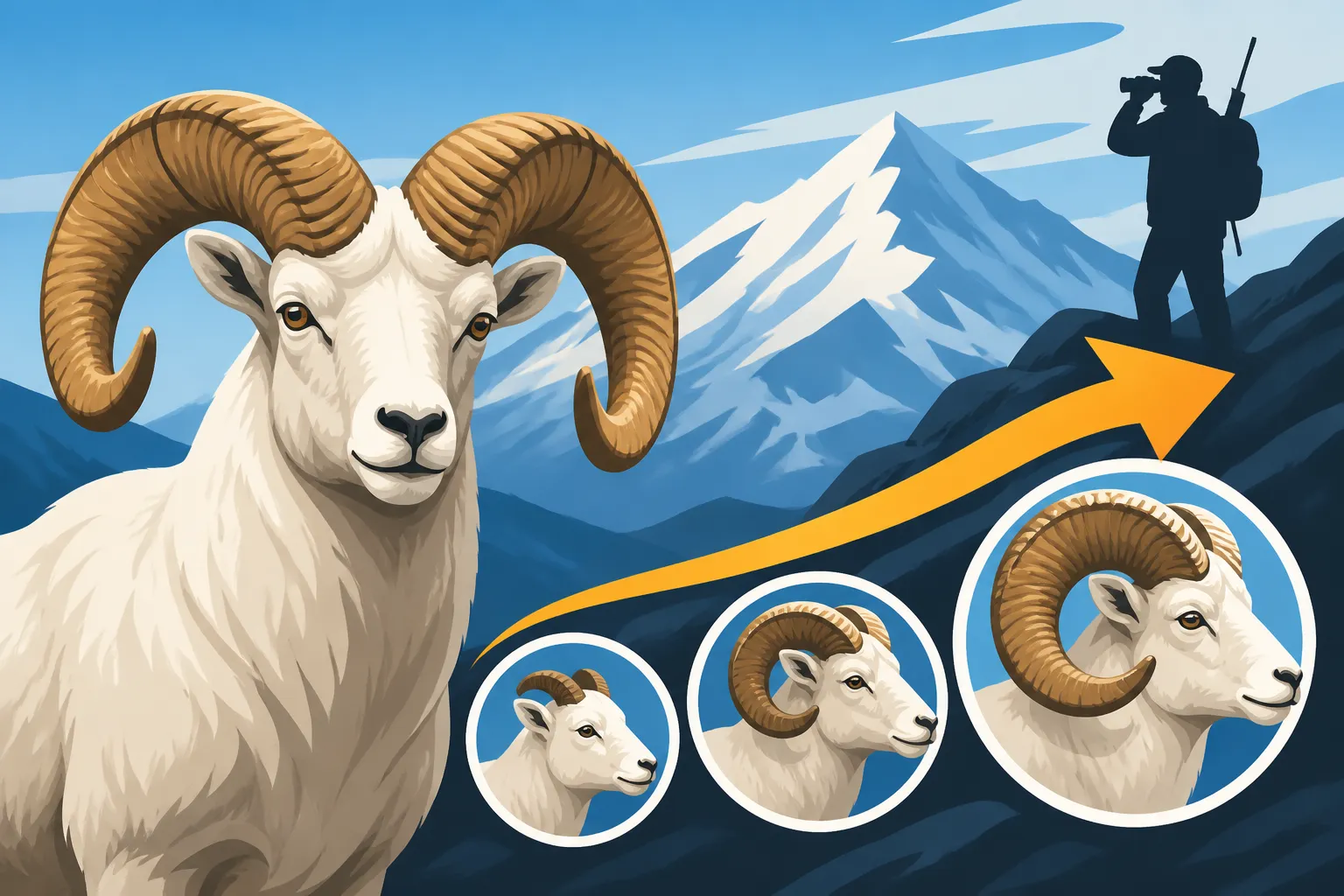
How Fast a Dall Ram’s Horns Grow
One of the most profound challenges and satisfactions for a Dall sheep hunter in Alaska is the art of field judging. It's more than just estimating length; it's about understanding the life story etched into a ram's horns, and central to that story is how quickly—or slowly—those magnificent horns grow. Many hunters, especially those new to sheep country, find themselves squinting through their spotters, trying to discern legality, and often, that comes down to a fundamental grasp of horn growth. This guide will take a deep dive into the fascinating world of Dall ram horn development, exploring the factors that shape them and what you can expect to see in the field.
The Intricacies of Dall Ram Horn Growth: Annuli Rings and Keratin
Dall sheep horns are truly marvels of nature, a permanent record of a ram's life. Unlike antlers, which are shed and regrown annually, horns are permanent structures made of keratin, the same protein found in your fingernails and hair, growing continuously from a boney core. This constant growth is what allows us to "read" a ram's age and health, year by year.
What Are Annuli Rings?
The most critical feature for aging a Dall ram in the field are the annuli rings. These are distinct, often deeply grooved annual growth rings that form on the horn. Each ring represents a period of slower growth, typically occurring during the harsh Alaskan winter months when food is scarce and energy is conserved for survival rather than rapid horn development. As the seasons change from the lean winter to the abundant summer, a new, more robust growth segment begins, creating a visible "ring" at the transition point.
Imagine a tree trunk with its growth rings; the concept is very similar. A young ram will show distinct annuli that are fairly close together initially, reflecting its rapid growth phase. As the ram matures, these rings might become more subtle, but they are always there, telling a precise story. Learning how to spot and count these rings, even on a live ram at a distance, is a foundational skill. We've talked before about Counting Annuli Rings on a Live Ram, and it truly is an art form that develops with practice and a good spotting scope.
The Role of Keratin in Horn Development
The horns themselves are layers upon layers of keratin. This material is incredibly tough and resilient, built to withstand the rigors of a ram's life, from navigating treacherous alpine terrain to the intense head-on collisions during the rut. The cells at the base of the horn, near the skull, are constantly dividing and producing new keratin, pushing the older horn material outwards and upwards. This steady, continuous process means that a ram's horns are literally always growing, albeit at varying rates depending on the time of year and the ram's overall condition. The quality of this keratin, its density, and integrity, is also influenced by the ram's diet and environment, leading to stronger, healthier horns in well-nourished animals.
Factors Influencing Dall Ram Horn Development
While the basic mechanism of horn growth is continuous, the rate and quality of that growth are subject to a complex interplay of environmental, genetic, and nutritional factors. It's never as simple as just "growing."
Nutrition and Habitat Quality
Just like any living creature, a Dall ram needs good nutrition to thrive, and that directly translates to horn growth. Rams living in areas with lush, high-quality forage—especially rich in minerals like calcium and phosphorus—will generally exhibit faster growth rates and develop thicker, denser horns. Conversely, rams in poorer habitats, perhaps where browse is sparse or mineral licks are few, might show slower growth and thinner horns.
Think about the difference between a garden hose with high water pressure versus low water pressure. The hose is always "on," but the output varies. Similarly, a ram's horn growth is always "on," but the influx of nutrients dictates its vigor. Seasons with abundant rainfall leading to rich vegetation can result in a discernible thicker growth segment between annuli. Conversely, a prolonged drought or a severe winter that leaves rams in poor condition can manifest as a thinner, more constricted annuli ring, sometimes even indicating a "skip" in growth if the stress was severe enough. For more on what these majestic animals consume, check out What Dall Sheep Eat Above Timberline.
Genetics and Individual Variation
While nutrition sets the stage, genetics provide the blueprint. Some rams are simply predisposed to grow larger, more impressive horns due to their genetic lineage. You might observe a particular basin or a specific segment of a herd producing rams with consistently larger horn bases or wider sweeps, suggesting a strong genetic component at play. This is why even rams sharing the same prime habitat can have noticeably different horn development patterns.
It's not uncommon to see a younger ram with genetics for impressive growth catch up to or even surpass an older ram with less genetic potential, even if the older ram had better early life conditions. This genetic lottery means that while general growth patterns exist, there's always an element of individual variation that makes field judging both challenging and endlessly fascinating. Platforms like GoHunt, with their extensive data on harvest records and unit-specific success, can sometimes provide glimpses into regional genetic trends, showing where hunters have consistently harvested larger-horned rams over the years, hinting at stronger genetics in those areas.
Environmental Stress and Weather Patterns
Alaska's environment is notoriously unforgiving, and extreme weather events or periods of prolonged stress can leave their mark on a ram's horns. A particularly harsh winter, characterized by deep, crusted snow, can make foraging incredibly difficult, leading to a period of greatly reduced horn growth. This stress can create a very tight, narrow annuli ring or even a complete cessation of growth for a short period, which is why some rings are harder to discern than others.
Beyond winter, environmental factors like disease outbreaks, predator pressure, or even significant habitat disturbances (like wildfires impacting forage) can divert a ram's energy away from horn production. A ram that expends significant energy fighting off illness or constantly evading wolves may show stunted horn growth during that period. This information, though not always obvious, is permanently recorded in the horn, offering a silent testament to the challenges the ram has endured throughout its life.
Growth Stages and What to Look For in the Field
Understanding the general progression of horn growth is crucial for accurate field judging and making ethical decisions. A ram's horns don't just get bigger; they change in character, mass, and shape over its lifetime.
Early Years: Rapid Growth and Formation
In their lamb and yearling stages, Dall rams begin to develop small nubs that quickly grow into noticeable spikes. The first few annuli rings will be fairly close together, indicating a period of rapid development. During this time, the emphasis is on establishing the basic structure and length. They are still learning to navigate the steep terrain of their home, as explored in discussions around Reading Sheep Country From a Glassing Knob, and their horns are growing proportionally to their body.
By the time a ram is 2-3 years old, its horns will be distinct, forming a "half curl" or more, but they will still appear relatively slender compared to a mature ram. The base circumference will be smaller, and the overall mass will be less impressive. This is a critical period for hunters to accurately identify these younger rams, ensuring they are not mistakenly harvested when specific age or curl restrictions apply.
Prime Years: Mass, Length, and the "Full Curl"
From about 4-5 years of age through 8-10 years, a Dall ram's horns enter their prime growth phase. This is when they gain significant mass, sweeping outward and upward, and eventually starting to curl around towards the face. The annuli rings during these years will be more pronounced, indicating strong seasonal growth. This is the stage when rams often reach the coveted "full curl" status, or at least a significant portion of it.
For non-resident hunters in Alaska, many Dall sheep hunts are subject to the "full curl" rule or specific measurements. A legal ram often means one whose horn tip has grown a full 360 degrees, or whose horn tip is broken, or whose ram is 8 years or older. This is where understanding growth is paramount. A 6-year-old ram might have impressive length, but if it hasn't quite achieved that full curl, it's not legal. You might want to refer to Full-Curl Rams and How Old They Are for more insight into this crucial aspect of judging. Learning to judge that curl, sometimes from tricky angles, as discussed in Full-Curl Judging From Below the Ram, is a skill that takes patience and experience. This is also the period when brooming, the natural wearing down of horn tips, might begin. We've often discussed Broomed Horn Tips and the Full-Curl Rule and how it impacts legality.
Mature Years: Maintenance, Brooming, and Character
As a ram ages beyond its prime (typically 9-12+ years), the rate of horn growth may slow slightly, but the horns continue to thicken at the base. Brooming becomes more common and often more extensive, as the ram uses its horns to dig for minerals, fight, and navigate. These older rams possess a distinct character in their horns—often rugged, heavily broomed, and with a pronounced basal mass.
While raw length might not increase as dramatically as in their younger years, the sheer mass and unique wear patterns tell a story of survival and dominance. These old warriors are truly magnificent, and their horns are a testament to their resilience in the unforgiving Alaskan wilderness. Setting up a patient observation post, perhaps a Setting Up a Spike Camp Above a Sheep Basin, allows you the time needed to thoroughly study these nuances.
Estimating Age and Legality: Beyond the Tape Measure
Successfully hunting Dall sheep means more than just finding a ram; it's about accurately judging its age and legality in the field, often under less-than-ideal conditions. This skill relies heavily on understanding horn growth patterns.
The Art of Field Judging Horns
Field judging is where all this knowledge comes together. It’s a synthesis of visual cues, experience, and patience. You’re not just looking for a large ram; you’re looking for a legal ram. This means paying close attention to the annuli rings, estimating the extent of the curl, observing the mass at the base and through the length of the horn, and noting any brooming.
A quick visual assessment might tell you a ram is large, but spending adequate time, sometimes for hours, glassing the animal is crucial to avoid a misjudgment. This is why discussions around How Long to Watch a Ram Before Shooting are so vital. Utilize your optics effectively, understanding the differences between Glassing at First Light Versus Midday to maximize visibility of key features. Many hunters find that reviewing trail camera photos or images from GoHunt's community sections of harvested rams can help calibrate their eye before a hunt, giving them a mental database of what different ages and curl types look like.
When Horns Deceive: Challenges in the Field
The environment can play tricks on your eyes. Lighting conditions, distance, and the angle of the ram can all distort your perception of horn growth and curl. A ram high on a distant ridge can appear smaller than it is, or conversely, a unique angle might make a horn appear to meet the full curl when it doesn't. Snow, shadows, or even a particular body position can obscure critical details like annuli rings or the precise arc of the horn tip.
This is why patience and careful, methodical glassing are non-negotiable. Using a high-quality spotting scope and tripod is essential. Zoom in, observe from multiple angles if possible, and take your time. If there's any doubt about legality, it’s always best to pass. A missed ram is far better than a legally questionable one. Preparing for your hunt also means knowing the specific regulations for your unit and understanding every nuance of the full-curl definition.
The Lifelong Journey of Horn Growth
From the tender nubs of a lamb to the battle-scarred, broomed towers of an old patriarch, a Dall ram's horns are a dynamic, ever-changing testament to its life. They tell a story of harsh winters, lush summers, and the genetic lottery that shapes their form. For the hunter, understanding this journey of growth isn't just about adherence to regulations; it's about a deeper appreciation for these magnificent creatures and the wild landscapes they inhabit. Every curl, every ring, every bit of brooming adds a chapter to that story, waiting to be read by those with the knowledge and patience to look closely.
| Ram Age (Years) | Typical Horn Characteristics | Growth Rate & Mass | Field Judging Notes |
|---|---|---|---|
| 1-2 | Small spikes, often under 8 inches, thin base. | Very rapid length growth, minimal mass. | Clearly sublegal, no curl formed. |
| 3-4 | Longer spikes, forming a quarter to half curl. Thin appearance. | Continued length growth, beginning to add some mass. | Still thin-looking, rarely approaching full curl. Annuli distinct. |
| 5-7 | Horns sweep wider, approaching or reaching full curl. Mass increases steadily. | Strongest period for mass accumulation and length. | Prime age for full curl and good mass. Look for distinct annuli. |
| 8-10+ | Full curl often reached or exceeded. Significant basal mass, heavy brooming possible. | Growth slows, but mass continues to accumulate at base. | Heaviest mass, often broomed tips. Annuli may be harder to count due to wear. |
This article is for general informational purposes only and does not constitute professional advice. Laws, prices and regulations vary by location and change over time. Consult a qualified professional for guidance on your specific situation.