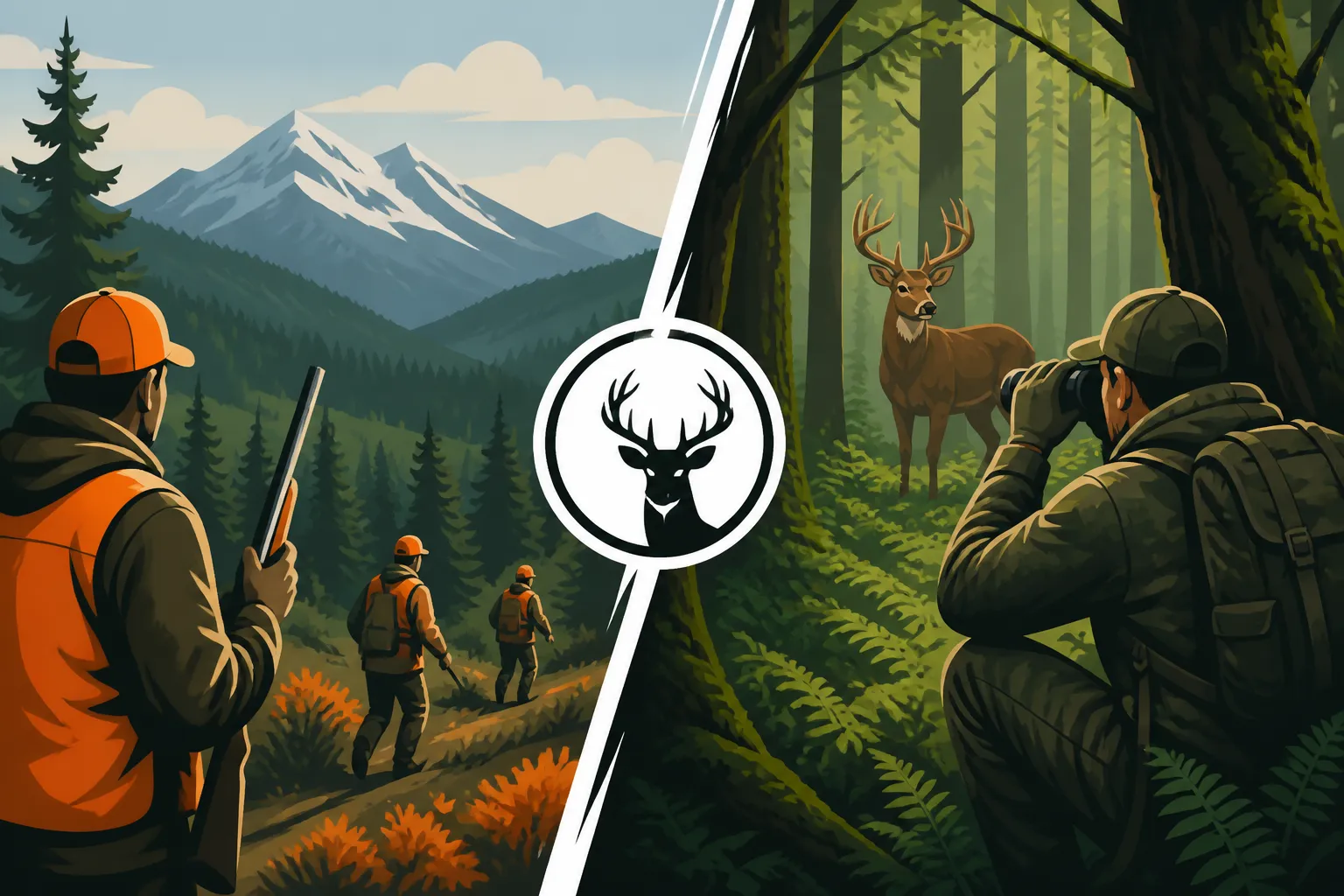
Deer Drives Versus Still Hunting in Southeast Alaska Timber
Hunting for Sitka blacktail deer in the dense, often relentless timber of Southeast Alaska can feel like trying to find a ghost in a green maze. The thick undergrowth, the constant dampness, and the deer's uncanny ability to disappear can make even the most seasoned hunter question their approach. This guide will meticulously compare two primary tactics—deer drives and still hunting—helping you decipher which method is best suited for the challenging rainforest environment and your hunting crew.
Understanding Southeast Alaska's Unique Deer Habitat
Southeast Alaska isn't just a place; it's an ecosystem unlike any other, especially when it comes to hunting deer. The very environment dictates how you hunt, and understanding its nuances is the first step toward success.
The Dense Coastal Rainforest Environment
Imagine a world where ancient Sitka spruce and western hemlock trees tower overhead, their branches dripping with moss and lichen. Below, the forest floor is a tangled mess of devil's club, blueberry bushes, salmonberry thickets, and dense ferns, all growing out of a spongy, saturated carpet of moss. This isn't just "timber" in the traditional sense; it's a coastal temperate rainforest, perpetually damp, often shrouded in fog or mist, and incredibly thick. Visibility can drop to mere yards, even on a bright day, making tracking and spotting game an arduous task. The terrain itself is often steep, uneven, and riddled with blowdowns, creating natural obstacles and hiding spots for deer. The incessant rain and the general cacophony of the forest, from dripping leaves to rushing streams, can both mask your movements and obscure the subtle sounds of deer.
Navigating this kind of landscape requires a specific mindset and an even more specific skill set. It's a far cry from the open expanses of the interior or the more navigable timber of other regions. You’re not just hunting deer; you’re battling the forest itself. This dense cover also provides ample hiding spots for animals and makes it challenging to maintain orientation, sometimes even requiring detailed planning using maps and tools like those found on GoHunt to mark potential escape routes and clearings before you ever step foot in the woods.
Sitka Blacktail Deer Behavior in Timber
Sitka blacktail deer are perfectly adapted to this challenging environment, which makes them incredibly elusive. Unlike deer in more open country that might bolt at the first sign of danger, blacktails in dense timber often prefer to "hold tight." This means they'll freeze, remaining absolutely motionless, relying on their camouflage and the thick cover to go unnoticed. They might let a hunter walk right past them at close range, only to slip away silently after the perceived threat has passed. Their coat color blends seamlessly with the browns and grays of the timber and moss, making them notoriously difficult to spot even when they are relatively close.
Their senses are incredibly acute, especially their hearing and smell. The damp air of the rainforest can carry scent for remarkable distances, and the rustle of a fern or the snap of a twig can be amplified in the quiet moments between rain showers. When they do decide to move, they can do so with astonishing stealth, slipping through brush that seems impenetrable to a human. This behavior makes a direct, head-on approach often futile. You also have to consider the overall health of the herd; sometimes after Deep Snow Winters and Alaska Deer Die-Offs, deer might be less concentrated or more wary, requiring even more patience.
The Art of Still Hunting in Southeast Alaska Timber
Still hunting is perhaps the most intimate way to hunt the timber, requiring immense patience, focus, and a deep understanding of the deer and their habitat. It's often a solitary pursuit, or for a very small, coordinated team.
Slow and Deliberate Movement Tactics
The core principle of still hunting in Southeast Alaska timber is extreme slowness. We're talking about moving perhaps 50-100 yards in an hour, sometimes less. Each step is a deliberate act. Before you lift a foot, you're scanning the ground for noisy debris – dry leaves (though rare in the rainforest), brittle branches, or loose rocks. You want to place your foot down softly, testing the ground with your toe or heel before committing your full weight. Mossy patches and wet soil are your allies, muffling footsteps better than almost anything else.
This isn't just about being quiet; it's about observation. You'll move a few steps, then pause, sometimes for minutes at a time. During these pauses, your eyes are constantly sweeping, not just for the whole deer, but for parts: a horizontal line that shouldn't be there, the flicker of an ear, a patch of contrasting color against the uniform green and brown. Using quality binoculars, even in thick cover, can help resolve details in shaded areas where your naked eye might miss a camouflaged form. The goal is to spot the deer before it spots you, giving you the advantage of a still target. This kind of nuanced movement also plays into how you might approach Shooting Positions on Alaska Tundra and Sidehills, where uneven ground is a constant challenge.
Reading Sign and Anticipating Deer Movement
Still hunting isn't just random wandering; it's a constant act of detection and deduction. You're looking for fresh deer sign to guide your path. This includes tracks in soft earth or mud, fresh droppings, and browse lines where deer have nipped at tender vegetation. Pay close attention to the freshness of these signs. Fresh droppings are shiny and moist; older ones are dull and dry. Similarly, fresh tracks will have sharp edges, while older ones will be rounded by weathering.
Beyond just finding sign, you need to interpret it. Are the tracks heading towards a bedding area, a feeding ground, or a water source? Consider the wind: deer will often bed down with the wind at their back, allowing them to smell danger approaching from behind while watching for threats in front. By understanding these patterns, you can anticipate their next move and position yourself for an encounter. Knowing the nuances of Blacktail Rut Timing in Southeast Alaska can also inform your strategy, as deer movements shift significantly during this period, often making bucks more vulnerable as they become less cautious.
Advantages and Disadvantages of Still Hunting
Still hunting offers a profound sense of solitude and connection with the wilderness, which many hunters cherish.
Advantages:
- Solo Hunter Autonomy: You can move at your own pace, change direction on a whim, and adapt instantly to new information without coordinating with a group. This is perfect for those who prefer to hunt alone or with a single, like-minded partner.
- Less Disturbance: A single, quiet hunter creates far less disturbance than a group. This means you're less likely to push deer out of an entire area, and more likely to encounter undisturbed animals acting naturally.
- Targeted Approach: You can focus on specific areas of promising habitat, working them meticulously. If you find fresh sign, you can slow down even further and dissect the area with extreme precision.
- Safety: Without multiple hunters moving and shooting in a coordinated (or sometimes uncoordinated) line, the inherent risks of a deer drive are virtually eliminated.
Disadvantages:
- Extremely Slow: This is not a method for those impatient or in a rush. It demands hours of slow, methodical movement, which can be physically and mentally taxing.
- Mentally Demanding: The constant focus required to move quietly and observe effectively can lead to fatigue. It's easy for attention to wane, and that's when you miss a crucial detail.
- Limited Visibility: Despite your best efforts, the dense timber often means your effective visibility is limited to a small bubble around you. Deer can appear and disappear quickly.
- Lower Success Rate (Potentially): While rewarding, still hunting can sometimes yield fewer opportunities compared to well-executed drives, especially in areas with very low deer density or extremely thick cover.
Executing Effective Deer Drives in Southeast Alaska
Deer drives are a team sport, leveraging multiple hunters to systematically move deer through dense cover towards waiting "standers." In the labyrinthine woods of Southeast Alaska, drives can be incredibly effective, but they demand meticulous planning and strict adherence to safety protocols.
Planning and Team Coordination
Successful deer drives begin long before anyone steps into the woods with a firearm. The first step is thorough scouting. You need to identify key bedding areas, natural travel corridors, and potential escape routes deer might use when pushed. Critically, you must pinpoint strategic locations for your "standers" – the hunters waiting silently for deer to be pushed towards them. These spots should offer clear shooting lanes and cover, allowing the stander to remain hidden but have an unobstructed view. Using topographical maps, aerial photos, and digital tools like GoHunt to visualize terrain and identify pinch points is invaluable.
Once the area is scouted, the team needs a precise plan. Assign roles: who are the "pushers" and who are the "standers"? Define the exact start and end points of the drive, the direction of the push, and the approximate speed of the pushers. Communication is paramount. Two-way radios are almost essential for maintaining contact, especially in thick cover where visibility is minimal. Discuss hand signals and specific verbal cues. Everyone needs to understand the plan perfectly, including where every other hunter will be at all times. For larger units, thinking about access points like those mentioned in Deer Islands Around Petersburg and Wrangell can help strategize where to launch drives.
The Role of Pushers and Standers
Each role in a deer drive is distinct and crucial for success.
Pushers: These hunters are responsible for moving through the designated area, actively attempting to push deer forward towards the standers.
- Movement: Pushers typically walk in a line, maintaining visual or auditory contact with each other to ensure a consistent front. The pace should be slow enough to be thorough but fast enough to keep deer moving.
- Noise Level: Pushers aren't usually trying to be silent. The amount of noise can vary; some drives call for a quiet, deliberate push to sneak up on deer and get them moving, while others might involve more purposeful noise (clapping, yelling softly, stomping) to get deer out of thick pockets. The goal is to make the deer feel pressured but not panicked into breaking the drive line prematurely.
- Staying in Line: Maintaining a consistent line is vital to prevent deer from slipping back through gaps. Pushers must be disciplined about their assigned lanes and communicate any difficulties or observations.
Standers: These hunters are positioned strategically at the "exit" points or along known travel routes, waiting for deer to be driven past them.
- Strategic Positioning: Standers need to be hidden but have a clear view of potential shooting lanes. They should position themselves downwind from the expected deer movement if possible, or use terrain features to their advantage. They must remain absolutely still and silent, as any movement or noise will alert approaching deer.
- Clear Lanes: Before the drive starts, standers should identify their shooting lanes and mentally note any obstacles. This is critical for safety and for making a clean shot.
- Understanding Escape Routes: Standers should know the most likely escape routes deer will take, allowing them to anticipate movement and be ready. This includes knowing that deer often follow paths of least resistance, like old game trails, creek beds, or natural saddles.
Safety Considerations for Deer Drives
Safety is the absolute priority in any deer drive. The inherent risks of multiple hunters moving in a confined, often low-visibility environment mean strict protocols are non-negotiable.
- Clear Fields of Fire: Every hunter, especially standers, must have a crystal-clear understanding of their safe shooting lanes. This means knowing exactly where other hunters are positioned and never taking a shot if there is any doubt about what lies beyond your target.
- Hunter Orange: Wearing plenty of hunter orange is mandatory in many areas and an absolute best practice in all others for drives in dense timber. This is your primary visual identifier to other hunters.
- Communication: Constant communication among the team is vital. Radios should be used to confirm positions, announce any deer sightings (with direction of travel), and, most importantly, signal the start and end of the drive.
- Pre-Hunt Briefing: A thorough pre-hunt briefing where the map is reviewed, roles are assigned, and all safety rules are reiterated is crucial. Discussing hypothetical scenarios (e.g., what to do if a deer doubles back) helps prepare everyone.
- Weapon Handling: Firearms should only be loaded when the drive is about to begin, and safety should always be engaged until a shot is imminent. Muzzles should always be pointed in a safe direction. The density of Southeast Alaska timber means hunters might consider different rifle types than they would for Rifle Calibers for Coastal Brown Bear, opting for something with less over-penetration or a faster-handling action for quick shots.
Comparing Still Hunting and Deer Drives: When to Use Which Method
Choosing between still hunting and deer drives in Southeast Alaska timber isn't about one being inherently "better," but rather which method is most effective for the specific situation, group, and conditions.
Situational Effectiveness Based on Terrain and Weather
The unique characteristics of Southeast Alaska terrain and its famously unpredictable weather play a huge role in determining the ideal hunting strategy.
- Still Hunting's Niche: Still hunting truly shines in smaller, more fragmented pockets of timber, or when you're targeting a specific, known bedding area. It's excellent for days with relatively calm winds and lighter rain, where your quiet movement is an advantage and you can still pick up subtle sounds. If you're exploring a new drainage or trying to locate deer in an unfamiliar area, still hunting allows for stealthy reconnaissance without blowing out an entire section. It's also suitable for hunting areas that are remote and accessed via methods like Packrafting Into a Roadless Alaska Drainage, where a large group for drives might not be practical.
- Deer Drives' Domain: Drives excel in large, uniform blocks of dense timber, clear-cuts that have grown up into impenetrable thickets, or areas with well-defined natural funnels (like narrow ridges or creek bottoms). They are particularly effective during periods of heavy rain or strong winds, as the ambient noise helps mask the pushers' movements and makes deer less likely to pinpoint the source of disturbance. The collective effort of multiple hunters can cover ground that would be nearly impossible for a single still hunter to work thoroughly, effectively pushing deer out of cover they would otherwise hold tight in. When conditions make visibility and quiet movement exceptionally difficult for one person, a coordinated drive can overcome those challenges by sheer force of numbers and strategy.
Hunter Numbers and Experience Levels
The size and experience of your hunting party will significantly influence the viability and safety of both methods.
- Still Hunting for Small, Experienced Groups: This method is ideal for solo hunters or a pair of highly experienced, disciplined hunters who understand the nuances of quiet movement, reading sign, and maintaining vigilance. Each hunter must possess a high degree of self-reliance and fieldcraft. It's not a tactic that lends itself well to larger, less cohesive groups, as the more people moving independently, the greater the chance of making noise or inadvertently bumping deer out of the area. Still hunting is a personal journey of stealth and observation, best undertaken by those who have honed these skills.
- Drives for Larger, Mixed-Experience Groups: Deer drives can accommodate a wider range of experience levels, provided roles are clearly defined and safety rules are strictly enforced. More experienced hunters can take on critical roles as pushers or standers in key locations, while newer hunters can learn the ropes in less demanding positions. A typical drive might involve 3-6 hunters, but larger areas could use more. The group dynamic allows for shared effort and the ability to cover more ground. However, the more hunters involved, the greater the need for precise coordination and communication. It's a method that requires a leader who can organize and execute the plan flawlessly, ensuring everyone understands their responsibilities and limitations.
Gear Considerations for Each Method
While core hunting gear remains constant, certain specialized items become more or less important depending on whether you're still hunting or driving.
- Still Hunting Essentials:
- Quiet Clothing: Fabric that doesn't rustle or make noise as you move is paramount. Soft shell jackets, fleece, and wool are preferred over noisy synthetics.
- Lightweight Optics: Compact binoculars are essential for spotting deer in thick brush. A small rangefinder can also be useful.
- Reliable Rain Gear: Since you'll be moving slowly or sitting for extended periods, highly waterproof and breathable rain gear is a must to stay comfortable and focused in the wet rainforest.
- Comfortable, Quiet Boots: Footwear that provides good traction on slick, uneven ground while minimizing noise is crucial.
- Deer Drive Essentials:
- High-Visibility Orange: As discussed, this is non-negotiable for safety. Hunter orange vests, hats, and even pack covers should be worn by all participants.
- Communication Devices: Two-way radios are invaluable for coordinating pusher movements and stander positions, especially when out of sight of one another.
- Durable, Weatherproof Clothing: While still important to be reasonably quiet, durability and extreme weather protection can be prioritized a bit more for pushers who will be moving through dense, abrasive cover. Good Game Bags That Breathe in Coastal Rain are also essential for packing out meat effectively after a successful hunt, regardless of the method.
- Reliable Firearm: Given the potential for quick, close-range shots in dense cover, a fast-handling rifle or shotgun with appropriate ammunition for deer is often preferred.
Maximizing Success in Southeast Alaska Deer Hunting
Regardless of the method you choose, a thoughtful approach that combines pre-season preparation with in-the-field savvy will significantly boost your chances of success in the challenging Southeast Alaska timber.
Pre-Season Scouting and Digital Reconnaissance
Before you ever step foot in the rainforest, the work begins. Pre-season scouting, both digital and on the ground, is critical. Start by utilizing satellite imagery and topographical maps, often available through platforms like GoHunt. Look for specific features that concentrate deer:
- Logging Clear-Cuts: Young clear-cuts with dense new growth provide excellent browse and cover. Older clear-cuts, perhaps 10-20 years old, can be especially productive as the vegetation reaches a sweet spot for both food and hiding.
- Natural Funnels and Pinch Points: Identify saddles between ridges, narrow valleys, creek bottoms, and dense transition zones between different types of habitat. These are natural travel corridors.
- South-Facing Slopes: These slopes often shed snow earlier and receive more sunlight, resulting in more forage, especially in the early and late seasons.
- Water Sources: While water is abundant in Southeast Alaska, knowing specific streams or seeps can sometimes reveal travel patterns.
Complement your digital scouting with actual boots-on-the-ground reconnaissance if possible. Look for older sign, established game trails, and areas with consistent browse pressure. This gives you a crucial baseline understanding of deer activity before the season even opens. When scouting a unit from Scouting a Unit From Satellite Imagery Before You Fly, pay close attention to the timber density and potential openings.
Understanding Deer Movement Patterns and Timing
Sitka blacktail deer, like all game, exhibit predictable movement patterns influenced by time of day, weather, and seasonal changes.
- Crepuscular Activity: Deer are most active during dawn and dusk. These are prime times for still hunting as deer move between bedding and feeding areas. During the middle of the day, they often bed down in thick cover, which is when deer drives can be particularly effective at getting them moving.
- Impact of Tides and Weather: In coastal areas, deer behavior can be influenced by tides. At low tide, deer may move onto beaches and mudflats to feed on seaweed or access new browse, offering unique hunting opportunities. Conversely, high tides might push them further into the timber. Pay attention to Tide Tables and Beach Deer Hunting to anticipate these movements. Heavy rain and wind, while challenging for hunters, can sometimes encourage deer to move more, as the noise helps mask their own movements.
- Rutting Behavior: The rut, typically in November in Southeast Alaska, significantly alters buck behavior. Bucks become more preoccupied with finding does, making them less cautious and more vocal. This period can offer excellent opportunities for both still hunting and drives, as bucks are more likely to be on the move during daylight hours. Understanding Blacktail Rut Timing in Southeast Alaska is key to capitalizing on this window.
Ethical Hunting Practices and Meat Care
Beyond the thrill of the chase, responsible hunting hinges on ethical practices and meticulous meat care.
- Shot Placement and Tracking: In dense timber, ethical shot placement is paramount. You often get a very small window, and the risk of a non-lethal hit is higher. Aim for vitals and be prepared for a challenging track. Even with a good hit, deer in thick cover can be incredibly difficult to locate. Marking the exact spot of the shot and the deer's last known direction is vital. If possible, have another hunter watch from a different angle to triangulate the impact point.
- Prompt Field Dressing: The mild, often damp, climate of Southeast Alaska means meat can spoil quickly, especially if the deer is not field dressed promptly. Once you've recovered your deer, get it gutted immediately to allow the carcass to cool down. In some areas, packing out a deer off a beach at Packing a Deer Off a Beach at Low Tide can be especially difficult, so quick field dressing is even more critical.
- Meat Cooling and Care: Even in cool weather, hanging meat in the open air to cool is essential. Use quality game bags to protect the meat from insects and dirt while allowing air circulation. If temperatures are above freezing, consider methods for accelerated cooling, and always prioritize getting the meat to a cooler environment as quickly as possible. Proper Meat Care in 50-Degree September Weather techniques are critical for preserving the quality of your hard-earned venison.
Still Hunting Versus Deer Drives: A Quick Comparison
Here's a straightforward look at the key differences to help you decide which tactic aligns best with your hunting situation.
| Feature | Still Hunting (Timber) | Deer Drives (Timber) |
|---|---|---|
| Group Size | Ideal for solo hunters or 1-2 highly coordinated partners | Requires 3-8+ hunters for effectiveness and safety |
| Visibility Needs | Relies on acute observation; effective within limited visibility | Standers need clear lanes; pushers need to maintain line visually or audibly |
| Noise Level | Extreme silence is paramount; slow, deliberate steps | Pushers create controlled disturbance; standers are absolutely silent |
| Terrain Suitability | Small, complex pockets of cover; varied terrain; specific bedding areas | Large, contiguous blocks of dense timber; clear-cuts; areas with natural funnels |
| Success Factors | Hunter's patience, observation skills, ability to read subtle sign | Meticulous planning, communication, disciplined execution, hunter numbers |
| Safety Concerns | Primarily individual safety (falls, animal encounters); low risk of hunter-on-hunter accident | High risk of hunter-on-hunter accident without strict adherence to safety protocols |
| Pace | Extremely slow, methodical (50-100 yards per hour) | Moderate pace for pushers; standers are stationary |
| Physical Demand | High mental focus; moderate physical for stealthy movement | High physical for pushers through dense brush; moderate for standers |
Disclaimer
The information provided in this guide is for general educational purposes only and is not a substitute for professional advice. Always consult the most current Alaska Department of Fish and Game regulations before embarking on any hunting trip. Hunting in Alaska carries inherent risks; ensure you are adequately prepared, equipped, and aware of all safety protocols.