Mistaking a Legal Bull for a Sublegal One
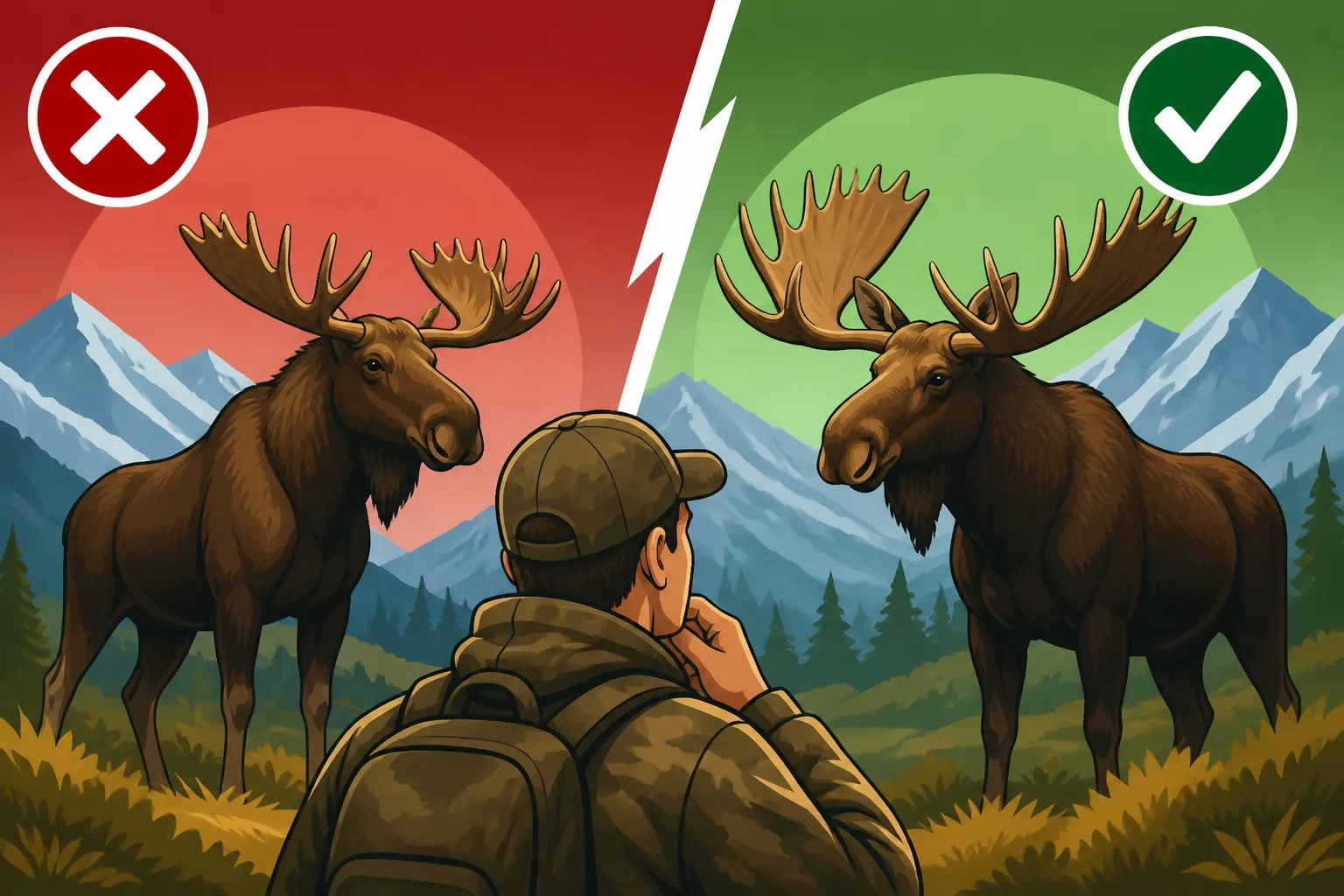
It's an experience every Alaska moose hunter dreads: seeing a magnificent bull, getting your heart rate up, scrutinizing its antlers through the fog or fading light, and ultimately deciding it's just not legal enough—only to discover later, through clearer photos or a hunting partner's second opinion, that you passed up a perfectly legal, mature animal. This guide will walk you through the nuances of Alaska's antler restrictions, helping you confidently identify legal bulls and avoid the crushing disappointment of mistaking a truly grand animal for a sublegal one.
The Heartbreak of a Missed Legal Bull
There’s a unique sting to passing on a bull you thought was too small, only to find out you were wrong. The vastness of Alaska, the challenging terrain, and the sheer size of these animals can play real tricks on your eyes. It’s not just about the rules; it’s about the psychological game of making a split-second decision in conditions that are rarely ideal. Hunters often beat themselves up for weeks, months, sometimes even years, over a bull that got away because of a misjudgment.
Understanding Alaska's Antler Restrictions
Alaska’s antler restrictions are in place for a good reason: to manage moose populations and ensure older, more genetically valuable bulls have a chance to breed. However, these regulations can be incredibly complex to apply in the field. Primarily, you're looking at two main types of antler restrictions, sometimes applied in combination or exclusively, depending on the Game Management Unit (GMU) you're hunting: the "50-inch spread" rule and the "spike-fork" rule.
The 50-inch spread rule mandates that a legal bull must have antlers with a spread of at least 50 inches. Now, imagine trying to measure 50 inches with a tape measure when the bull is 300 yards away, trotting through willows, or standing in thick timber! It's a daunting task that relies heavily on visual estimation. Many hunters err on the side of caution, assuming a bull is smaller than it actually is, especially if they haven't seen a truly massive bull recently for comparison. The frustration often stems from the fact that many younger bulls can have impressive looking antlers, but still fall short of that critical 50-inch mark. For a deeper dive into these regulations, you might want to read our guide on Alaska Moose Antler Restriction Areas.
Then there's the spike-fork rule, which often states that a legal bull must have at least one antler with a spike or a fork. This sounds simpler, right? Just look for a point. But what constitutes a "fork"? Is it a small nub? A clearly defined split? The definition can sometimes feel subjective in the field, especially when antlers are covered in velvet, partially obscured by brush, or silhouetted against a bright sky. A young bull might have what appears to be a spike or fork, only for closer inspection to reveal it doesn't meet the legal definition. Conversely, a mature bull with heavily palmated antlers might present a challenging profile, where distinct spikes or forks are hard to discern.
Why Perception Can Play Tricks
Hunting in Alaska means contending with some of the most challenging environmental conditions imaginable. These factors conspire to make accurate field judging a genuine skill, not just a casual observation.
Distance: This is arguably the biggest culprit. The further away a moose is, the more difficult it is to accurately gauge its antler spread or the presence of specific points. What looks like a 40-inch spread at 400 yards could easily be 55 inches when it walks closer. Conversely, a bull that appears to have an immense rack might shrink as you close the distance. Our brains aren't naturally calibrated for precise distance estimation in open, featureless terrain, and Alaska has plenty of that.
Light Conditions: Flat light, the harsh glare of a midday sun, or the deceptive shadows of dawn and dusk can dramatically alter how antlers appear. In low light, the fine details needed to count points or define a fork can disappear entirely, turning distinct features into blurry masses. During a bright, sunny day, glare can make it hard to see the underside of palms or the tips of points. This makes the crucial first and last hours of hunting notoriously difficult for accurate judging.
Terrain and Cover: A bull standing in an open burn scar might look one way, but the same bull standing in dense willow thickets or partially submerged in a beaver pond presents an entirely different challenge. The surrounding environment provides no consistent reference points. A moose standing on a slight incline can make its antlers appear smaller or larger than they truly are. It’s like trying to judge the size of a fish in murky water; you only get glimpses and shadows.
Adrenaline and Excitement: Let's be honest, seeing a bull moose in the wild, especially after days of hard hunting, is a rush. That adrenaline surge, while essential for the hunt, can cloud judgment. Under pressure, the brain tends to seek quick answers rather than engage in careful, deliberate analysis. This is where hunters can be too quick to dismiss a bull as "not quite" legal, rather than taking the extra moments needed to be certain. It's a common trap, and one that requires conscious effort to avoid.
Key Indicators for Identifying a Legal Bull
To confidently make the call in the field, you need to arm yourself with specific visual cues and a systematic approach. Don't rely on gut feelings alone; train your eyes to spot the details.
The 50-Inch Spread Rule: More Than Just Guesswork
The 50-inch spread rule is a cornerstone of moose hunting in many Alaska units. Many hunters struggle with this because 50 inches is bigger than most people intuitively think, especially from a distance. A standard doorway is usually 30-36 inches wide, so imagine a rack almost twice that width.
One of the most reliable visual cues for estimating 50 inches is to compare the antler spread to the width of the moose's body. A mature bull's body is typically around 25-30 inches wide at the shoulders. If the antler spread extends significantly beyond the bull's ears when viewed from the front, and definitely wider than its body, you're likely looking at a 50-inch plus bull. Think of it this way: if the main beams extend beyond the edge of its brisket by a good margin on both sides, it's a very strong indicator. Another good trick: a mature bull's ears are roughly 10-12 inches long, and the distance between the tips of its ears can be around 24-28 inches. If the antlers stretch out two full "ear lengths" beyond the tips of its ears, you're almost certainly looking at a legal bull. For practical tips, check out Measuring a 50-Inch Spread Against Your Rifle.
Your rifle can also be a surprisingly effective measuring tool. Most hunting rifles are around 40-48 inches long. If a bull's antlers look like they could easily accommodate the length of your rifle, or even exceed it, you're likely in the clear. Of course, this requires familiarity with your rifle's exact length and a steady hand to make the comparison, but it’s a time-tested technique. Remember, the legal definition for the 50-inch spread is the greatest distance between the outermost points of the antlers. It's not the palm width, but the absolute widest point.
The Spike-Fork Rule: Looking for the Points
The spike-fork rule, or "brow tine" rule in some areas, requires a bull to have at least one antler with a spike or a fork, or a specific number of brow tines (often three). The common mistake here is underestimating what constitutes a "fork." A fork needs to be a clear division of the antler into two distinct points, not just a bump or a slight curve.
When you're trying to determine if a bull has a legal spike or fork, focus your optics intently on the ends of the main beams and any visible tines. Look for clear separation. If you can draw a definite line between two points, and they aren't just one continuous mass, it's a fork. A "spike" is typically a single, unbranched point at least an inch long. Again, don't confuse small bumps or irregular growth patterns for true spikes or forks. It's about clear, distinct separation. Many hunters err by being too conservative, fearing a citation for Mistaking a Legal Bull for a Sublegal One when in fact the bull is legal. Understanding the Spike-Fork Legal Definition in Alaska is crucial here.
It's also worth noting that some regulations specify a minimum length for these points. Always double-check the current Alaska Department of Fish and Game regulations for your specific GMU, as these rules can vary slightly. Sometimes, even what looks like a single brow tine could be a small fork if you get a better angle or more magnification.
Body Size and Antler Mass as Clues
While not definitive on their own, a bull's overall body size and the general mass of its antlers can provide strong supporting evidence for legality, especially when combined with spread or point observations.
Older, mature bulls in Alaska are simply enormous. Their bodies are deep-chested, thick-necked, and often darker in color than younger bulls. They carry a lot of muscle, especially in their shoulders. If you see a bull that looks like a small horse, massive and imposing, its antlers are highly likely to meet legal requirements, even if the precise spread or point count is hard to make out immediately. Younger bulls, even those with decent antler growth, tend to have lankier bodies and thinner necks. The sheer bulk of a mature bull's body provides an important scale reference.
Similarly, the overall mass of the antlers themselves is a good indicator. Mature bulls typically have thick, heavy main beams and substantial palms, often with numerous points or "fingers" along the edges. The antlers won't look thin or spindly. They'll have a robustness that speaks of age and good nutrition. If a bull's antlers seem disproportionately small or thin for its body, it might be a younger animal whose antlers haven't quite reached the legal threshold. However, this is not foolproof. Some areas produce bulls with very wide but relatively thin antlers, while others produce bulls with heavy, compact racks. Use this as a supporting clue, not the primary deciding factor.
Practical Strategies for Accurate Field Judging
It’s one thing to know the rules, and another to apply them effectively under pressure. Developing a systematic approach in the field is your best defense against misjudgment.
Patience and Optics are Your Best Friends
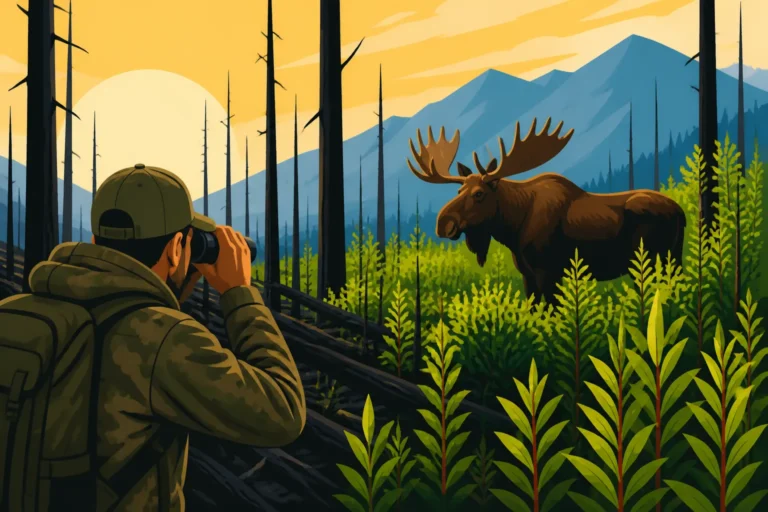
In Alaska, time is often your greatest ally when it comes to judging a bull. Resist the urge to rush. Once you spot a bull, your first instinct might be to close the distance or prepare for a shot. Instead, slow down. Get comfortable, get out your optics, and observe. This is where high-quality binoculars and a spotting scope on a sturdy tripod become indispensable.
Take your time with your glass. Don't just glance; scrutinize. Start by observing the bull's overall behavior, then systematically move to its antlers. From a distance, even small differences become clear with good magnification. A spotting scope, especially one with a high power range, allows you to pick apart antler configurations, count individual points, and confirm that critical 50-inch spread. I always recommend spending at least 15-20 minutes, if the situation allows, just watching the bull through my Glassing the Alaska Range: Finding Game Before You Move setup. Wait for the bull to turn its head, walk, or even lie down, giving you different angles and opportunities to confirm legality. Remember, a quick glance often leads to regret.
Using Environmental Cues for Scale
The Alaskan landscape, while vast, does offer natural reference points that can aid in field judging. You just have to be observant and know what to look for.
Look for familiar objects in the immediate vicinity of the moose. Is there a small spruce tree that you know is approximately 6 feet tall? How do the antlers compare to that? Is there a particular rock that you estimate to be two feet wide? Use that as your mental measuring stick. Often, a moose will be standing near brush, small trees, or even other animals. Comparing the antler spread to the width of a specific bush or the height of a willow clump can provide valuable context. Just be sure to verify the true size of your reference object if you can, either by walking to it later or by comparing it to something else you know the size of.
If a cow moose or a calf is nearby, use them as a size reference. While not perfectly accurate for antler spread, they give you an idea of the bull's overall body size and how its antlers scale against a known animal. This is especially helpful if you're trying to differentiate a mature bull from a smaller, younger one that might have decent, but not legal, antlers.
Pre-Season Study and Practice
The best time to learn to field judge is before you're standing in front of a live bull with your heart pounding. Immerse yourself in the regulations and practice.
Before heading into the field, spend time studying the specific antler restrictions for your chosen GMU. The Alaska Department of Fish and Game (ADF&G) regulations booklet is your Bible. Pay close attention to the exact wording regarding spike-fork definitions and spread measurements. Many online resources, including hunting forums and platforms like GoHunt, offer detailed breakdowns and visual aids that can help. GoHunt, for example, often provides unit-specific information that highlights these nuances. Make sure you understand Why Antler Restriction Hunts End in Citations.
Practice at home. Look at photos and videos of moose, particularly those from Alaska, and try to apply the rules. Imagine you're in the field and have to make a call. There are even apps and online quizzes designed to help hunters practice field judging. The more you train your eye, the more confident and accurate you’ll be when it counts. Familiarize yourself with how a 50-inch spread actually looks, and what a legal spike or fork unequivocally defines.
| Indicator | 50-Inch Spread Rule | Spike-Fork Rule | Body Size / Mass Clues |
|---|---|---|---|
| Primary Visual | Antlers extend significantly beyond ears/body width. | Clear, distinct points/forks (minimum 1-inch separation). | Deep chest, thick neck, robust frame. |
| Distance Aid | Compare to rifle length (approx. 40-48"). | Focus optics on antler tips/edges; look for separation. | Bull appears "horse-sized," much larger than cow. |
| Common Mistake | Underestimating spread; thinking 40" is 50". | Confusing bumps/irregular growth with true forks. | Relying solely on size; young bulls can be big. |
| Confirmation Tip | Antlers noticeably wider than twice the distance between ear tips. | Wait for clear view of antler tips; use high magnification. | Observe gait, neck thickness, general bulk. |
Avoiding the Pressure Cooker Mistakes
Even with all the knowledge and practice, the moment of truth in the field can be overwhelming. Recognizing and managing the psychological aspects of the hunt is as important as knowing the regulations.
The Adrenaline Factor
The sheer excitement of spotting a legal bull, especially one you’ve worked hard for, can trigger a rush of adrenaline that makes calm, rational judgment difficult. Your heart pounds, your hands might shake, and you feel an intense urge to act now. This is precisely when mistakes happen. You might see what you want to see, or gloss over critical details.
To combat this, develop a mental "checklist" or routine. Once you've spotted a potential shooter, force yourself to take three deep breaths. Lower your rifle, even if just for a second, and tell yourself to slow down. Then, methodically go through your judging process:
- Glass thoroughly: Binoculars first, then spotting scope if available.
- Estimate spread: Use the ear-to-ear or body-width method.
- Check for points: Scrutinize each antler for legal spikes or forks.
- Confirm overall impression: Does the body size match a mature animal?
Don't pull the trigger until you've mentally checked all the boxes. It's far better to let a potentially legal bull walk than to risk a citation or, worse, injure an animal illegally.
Hunting Alone Versus With a Partner
The choice to hunt alone or with a partner significantly impacts field judging, particularly in high-pressure situations.
Hunting solo offers unmatched solitude and the satisfaction of a self-reliant pursuit. However, it also means you bear the full weight of judgment. There's no one to bounce ideas off, no second set of eyes to confirm a spread or count points. In those critical moments, self-doubt can creep in, or overconfidence can lead to hasty decisions. If you primarily hunt alone, cultivating extreme patience and meticulous observation habits is even more vital. Carrying multiple optics and using a communication device like an InReach for check-ins, as discussed in Signal Devices and Check-In Plans for Solo Alaska Hunts, can also help you stay grounded.
Hunting with a partner provides a crucial advantage: a second opinion. When you spot a bull, both of you can glass it independently, then compare notes. "I think he's 52, and definitely has a fork on his left." "No, I'm only seeing 48, and that fork looks more like a bump to me." This dialogue forces both hunters to re-evaluate, look from different angles, and ensure a consensus on legality. It distributes the pressure and minimizes the chance of one person's adrenaline-fueled mistake. Plus, if one hunter has a clearer view or better angle, their input can be invaluable. This collaborative approach can save you from a major regret.
What to Do After the Shot if Doubts Remain
Despite your best efforts, sometimes after the shot, or once you approach a downed animal, you might find yourself with lingering doubts about its legality. This is a stressful situation, but knowing what to do immediately can prevent further problems.
Post-Kill Due Diligence
The moment you reach your downed moose, your priority is to confirm its legality before you put your tag on it or begin Quartering a Bull Moose Alone in the Field. Even if you were 99% sure in the field, now is the time to be 100%.
Get out your tape measure (a small, flexible one is invaluable for hunters) and physically measure the antler spread if that was your restriction. Go from the widest point of one antler to the widest point of the other. If it’s a spike-fork rule, physically examine the points, ensuring they meet the minimum length or distinctness requirement. Don’t just eyeball it; measure it precisely. If, at this point, you discover the bull is sublegal, it's a gut-wrenching moment. However, it's critical that you do not attempt to tag the animal. Tagging a sublegal animal is a serious violation.
Instead, contact the Alaska Wildlife Troopers immediately. Be honest and transparent about what happened. Explain your field judging process, the conditions, and how you made the mistake. The Troopers appreciate honesty and cooperation. While there might still be consequences, being forthright is always better than attempting to conceal a violation. They will guide you on the next steps, which might include confiscation of the animal and a potential citation, but an honest mistake handled properly is viewed very differently than a deliberate attempt to break the law. This emphasizes the importance of understanding all Alaska Harvest Tickets, Registration Permits and Draw Permits and their implications.
Disclaimer
Please remember that hunting regulations and laws can change. This guide is intended for informational purposes only and does not constitute legal advice. It is your sole responsibility to review and understand the current Alaska Department of Fish and Game regulations for the specific Game Management Unit you are hunting before heading into the field. Always prioritize safety and ethical hunting practices.