Glassing Grids That Cover a Whole Basin
It’s a familiar scenario for anyone who’s spent time hunting in Alaska: you’re staring out at an impossibly vast basin, a sprawling expanse of tundra, rock, and willow that stretches for miles, and the sheer scale of it feels paralyzing. How on earth do you effectively search such a massive area for a tiny, camouflaged animal? This guide will break down the frustration of trying to find game in these immense landscapes and show you exactly how to implement methodical glassing grids to systematically cover an entire basin, ensuring you don't overlook that trophy animal hidden in plain sight.
Why a Grid System is Essential in Alaska's Vast Landscapes
Alaska’s terrain is legendary for its wild, untamed beauty, but for hunters, that vastness often translates to a profound challenge. Unlike hunting in more confined areas, the sheer scale of an Alaskan basin can make traditional "look-around-and-see-what-pops-up" methods incredibly inefficient, leading to missed opportunities and wasted effort. A systematic approach isn't just a good idea; it's often the difference between success and going home empty-handed.
The Overwhelm of Open Country
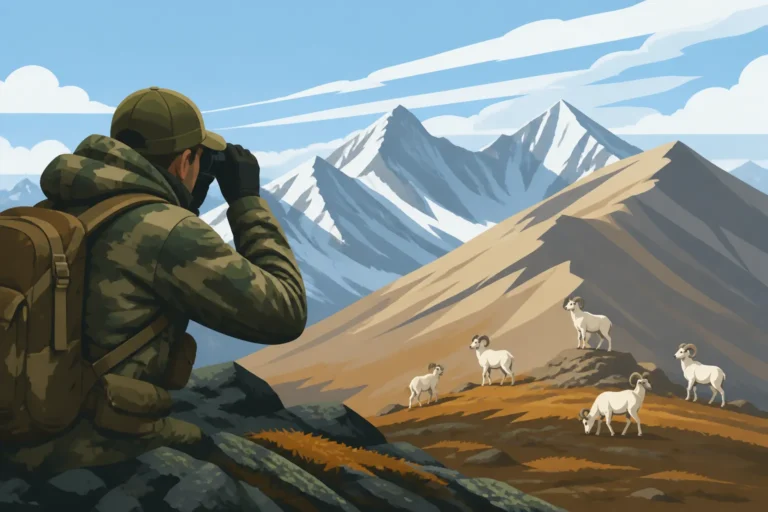
Imagine sitting on a knoll overlooking a basin that's five miles wide and seven miles long. Every rock seems like an animal, every patch of willow could hide a bedded moose, and the distant shadows play tricks on your eyes. It’s easy to feel overwhelmed, to just pick a spot and scan haphazardly, hoping for a flicker of movement. The problem is, this random scanning almost guarantees you’ll miss something. Your eyes get tired, your focus wavers, and without a deliberate plan, you'll inevitably skip critical sections of terrain. This feeling of being swallowed by the landscape is precisely why a structured approach is so vital. It brings order to the chaos and gives you a tangible method for breaking down the insurmountable into manageable pieces.
Minimizing Hunter Error
Even the most seasoned hunters can make mistakes in judgment, especially when fatigue sets in or the weather turns. A grid system, however, acts as a checklist, forcing you to systematically cover every inch of your chosen hunting area. It reduces the chance of human error by creating a repeatable process. You're no longer relying solely on intuition or fleeting glances, but rather on a disciplined technique that forces your eyes to scrutinize every nook and cranny. This is especially critical for animals like Dall sheep or caribou, which can blend seamlessly into their rocky or tundra environments, or a bedded bull moose whose antlers might just peek above the willows. By forcing yourself to move through a grid, you increase your odds of picking up a subtle shape, a slight color difference, or the glint of an antler that you would otherwise have zipped right past.
Maximizing Limited Time
Hunting in Alaska often involves significant investment, whether it’s in time, money, or both. For many, especially those on a fly-in hunt with a strict pickup schedule, every minute in the field counts. Wasting hours scanning aimlessly or repeatedly looking at the same areas due to lack of a plan can be incredibly detrimental. A well-executed glassing grid dramatically improves efficiency. Instead of feeling like you’re trying to find a needle in a haystack, you’re systematically reducing the size of the haystack, making the needle much easier to find. This allows you to cover more ground, more thoroughly, in less time, freeing up valuable hours for stalking, packing, or even moving to a new drainage if your initial basin proves barren. It's about working smarter, not just harder, to make the most of your precious time in the Alaskan bush.
Setting Up Your Glassing Station for Success
Effective glassing isn't just about having good optics; it's about optimizing your entire setup. The best glassing grid in the world won't do you much good if you're uncomfortable, exposed, or can't see properly. Think of your glassing station as your temporary command center—it needs to be stable, strategic, and comfortable enough for long hours of intense observation.
Choosing the Right Vantage Point
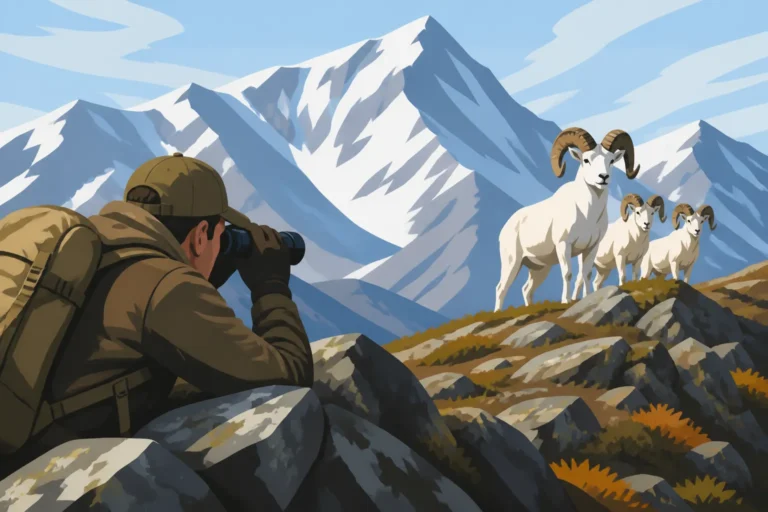
Selecting the ideal glassing knob or ridge is paramount. You want a position that offers the widest possible view of your target basin, but it's not just about height. Look for elevation that provides an unobstructed panorama, allowing you to see into draws, along benches, and across open flats without "dead spots" or hidden terrain. Often, this means a ridge that gives you multiple angles into the basin below. Consider the prevailing wind direction; you want to be upwind or crosswind from where you expect to find game, especially if you plan to move on them. The sun's position is also crucial. Whenever possible, position yourself so the sun is at your back, illuminating the areas you're glassing. This reduces glare and helps highlight animals against the landscape. Imagine a sheep basin in the Alaska Range; a south-facing slope with good visibility to several drainages, perhaps with a slight crosswind, would be a prime candidate. This is where Reading Sheep Country From a Glassing Knob becomes invaluable.
Essential Gear for All-Day Glassing
Long hours behind glass demand the right tools. Your binoculars are your primary scouting instrument. Many hunters favor a quality pair of 10×42 or 12×50 binoculars for general scanning, offering a wide field of view and decent magnification. For really dissecting distant terrain, especially in vast open country, 15×56 binoculars are a game-changer, but they absolutely require a tripod for stability.
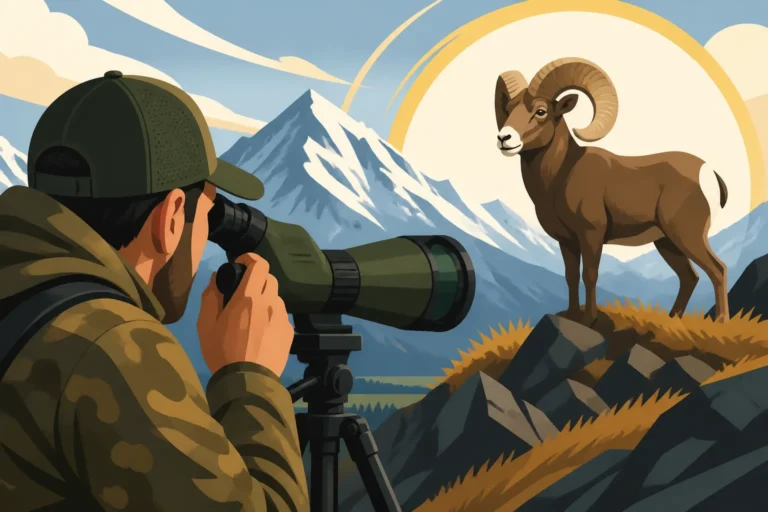
A spotting scope is your closer-range examination tool. A 60-80mm objective lens is typical, with variable magnification up to 60x or even 80x. This is how you'll Spotting Scope Power for Ram Judging or confirm antler points on a distant bull moose. Brands like Swarovski, Zeiss, Vortex, and Maven produce excellent optics. I personally use a set of Vortex Razor HD binos and a Razor HD spotting scope, and they've never let me down.
Crucially, all these optics need a sturdy tripod. Forget trying to handhold 15x binoculars or a spotting scope for more than a few minutes; the wobble will strain your eyes and cause you to miss detail. A lightweight, carbon fiber tripod is ideal for backpack hunting, allowing you to quickly set up a stable platform. Don't skimp on a good tripod head either – fluid movement and rock-solid locking are key. Ensure your Tripod Height for All-Day Glassing is comfortable for sitting, standing, or even lying prone if needed. Finally, don't underestimate comfort: a small foam pad or inflatable cushion can make hours of sitting much more bearable.
Managing Light and Weather
Alaska’s weather is famously unpredictable and can change your glassing conditions in a heartbeat. The angle of the sun profoundly affects visibility. Glassing at First Light Versus Midday requires different tactics; early and late light often create long shadows that can hide animals, but also highlight them against sunlit slopes. Midday sun, while bright, can wash out detail. Position yourself to minimize glare, and use the sun to your advantage to illuminate your target areas.
Fog, rain, and snow present their own challenges. When fog rolls in, your grid system might need to be paused, or you might need to shift to a different vantage point to cover a lower, clearer section of the basin. Rain reduces visibility and can make optics foggy, so good lens covers and a rain fly for your spotting scope are essential. Snow, especially fresh snow, can make animals stand out, but heavy snowfall can completely obscure your view. Adaptability is key; sometimes you just have to wait out a weather system, or shift your focus to areas less affected. Remember, if you can’t see effectively, you can’t glass effectively.
Implementing the Basin Glassing Grid Technique
Now that you're in the right spot with the right gear, it's time to put the grid system into action. This methodical approach is about dissecting the landscape, piece by careful piece, until every possible hiding spot has been thoroughly examined.
Dividing the Basin into Manageable Sectors
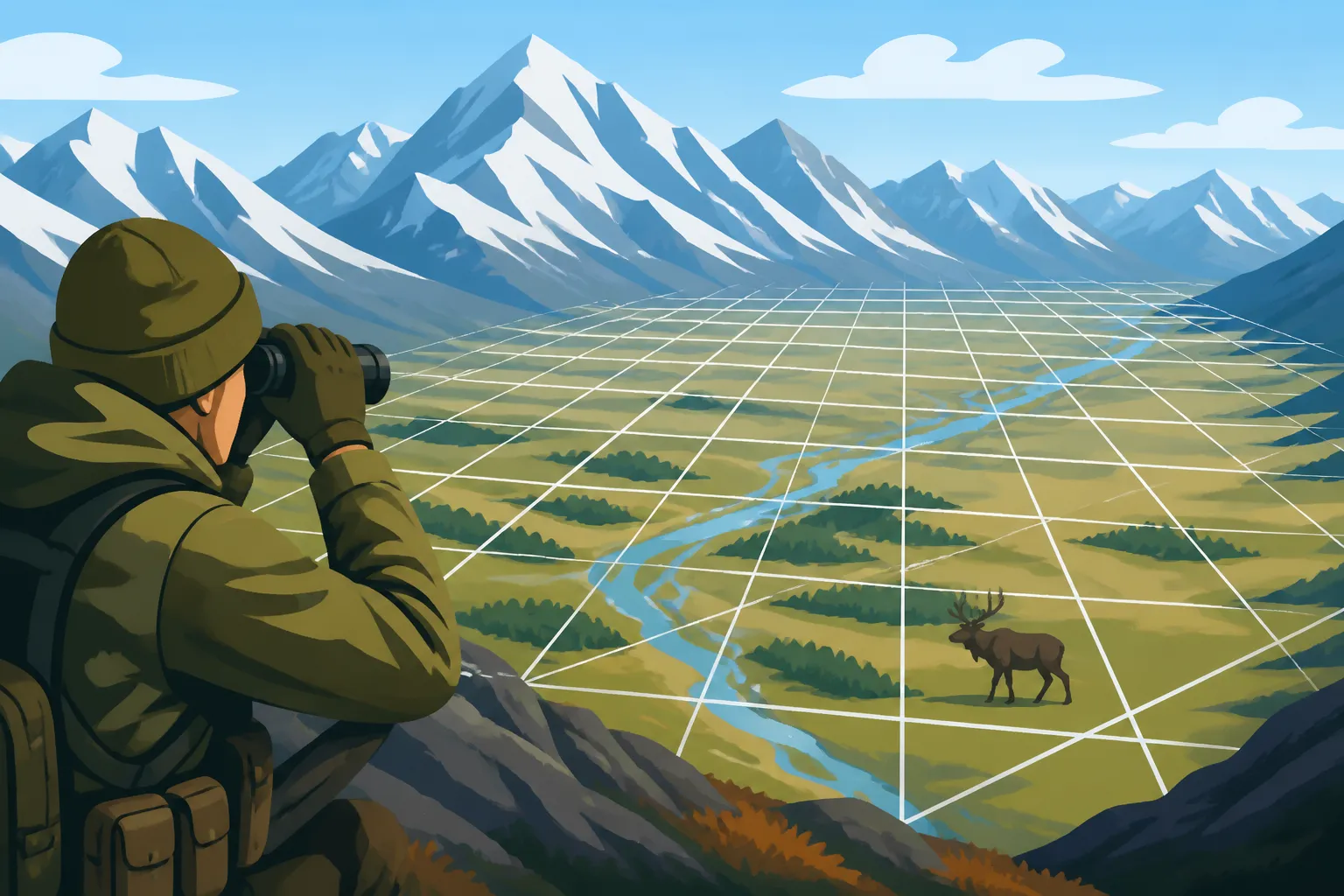
The first step in any effective grid system is to break down that overwhelming basin into smaller, more digestible sections. Mentally, or even physically if you have a mapping app like GoHunt on your phone, divide the basin into "strips" or "squares" using prominent natural features. Think of ridgelines, major drainages, bands of timber, rockslides, or distinct changes in vegetation as your boundaries.
For example, a large sheep basin might be divided by a prominent creek bed running through its center, creating a left and right half. Each half can then be broken down further by smaller fingers or benches. You might mentally assign a number to each sector: "Sector 1: lower left bench below the rock slide," "Sector 2: mid-slope willows leading to the timberline," and so on. This pre-visualization helps you maintain discipline and ensures you don't inadvertently skip areas. It's essentially creating a map in your mind, or on your screen, of where your eyes need to go. If you've done any pre-scouting using satellite imagery, you'll already have a head start on marking these sections.
The Overlap and Zigzag Method
Once your basin is segmented, the real work begins. Pick a starting point for your first sector—I usually recommend starting at one end of the basin (left or right, top or bottom) and working your way across, then down, like reading a book.
Here's the critical part: using your binoculars (or spotting scope, though binoculars are faster for initial sweeps), start at the furthest point of your chosen sector. Slowly, agonizingly slowly, move your optics across the landscape. The key is to slightly overlap your field of view with each movement. Think of it like mowing a lawn; you don't just cut a strip and then jump to the next, you slightly overlap the previous pass to ensure no blades of grass are missed.
As you sweep horizontally, pay attention to different depths. Look at the furthest ridgeline, then bring your focus slightly closer to the mid-slopes, then closer still to the foreground. Once you’ve completed a horizontal sweep across your sector, drop your optics down slightly (about half a field of view) and sweep back the other direction. This creates a zigzag pattern that ensures thorough coverage. Don't rush this process; spend seconds, even a minute, on each small segment, allowing your eyes to adjust and pick out subtle details. This is especially true when Glassing at First Light Versus Midday as shadows can play tricks.
Prioritizing Key Game Areas
While the grid system emphasizes comprehensive coverage, it doesn't mean all terrain is equal. Once you're comfortable with the methodical sweep, you can — and should — prioritize specific areas within your grid where game is more likely to be found. These are your "high-probability zones" where you'll spend extra time dissecting the landscape.
For Dall sheep, focus on rocky outcroppings, mineral licks, and the benches just below major cliff faces. For caribou, look for animals on open tundra, especially along traditional migration routes, and near water sources. When hunting moose, pay extra attention to willow flats, creek bottoms, and the edges of timberlines, particularly those areas that are Willow Flats Versus Spruce for Bull Moose. Think about what the animal needs: food, water, cover, and security.
Spend more time picking apart shaded areas on hot days, or sunny slopes on cold days. Look closely at areas with fresh tracks or known bedding sites. Use your mapping tools, like GoHunt's satellite imagery, to identify these prime habitats before you even step foot in the field, and then mark them as priority points within your grid. These specific areas warrant a slower, more deliberate sweep, perhaps even switching to your spotting scope for a more detailed examination before moving on.
Common Mistakes and How to Avoid Them
Even with the best intentions and the most methodical approach, it's easy to fall into traps that undermine your glassing efforts. Alaska hunting is tough, and avoiding these common pitfalls can significantly improve your success rate.
The "Speed Glassing" Trap
One of the most pervasive mistakes hunters make, especially when staring at a massive Alaskan basin, is "speed glassing." It's tempting to want to cover ground quickly, zipping your binoculars across the landscape in broad, sweeping motions. You feel like you're being productive because you're "seeing" a lot of country. However, this is exactly what leads to missed animals. Game animals, especially big game in Alaska, are masters of camouflage and stillness. A bedded Dall ram against a gray rock face or a caribou partially obscured by tundra can be virtually invisible if you don't give your eyes time to process the image.
The antidote to speed glassing is patience. Force yourself to slow down. When you scan horizontally, pause at regular intervals and let your eyes truly soak in the detail. Look for unusual shapes, slight color variations, or patterns that don't quite fit the natural environment. Think of it like a "spot the difference" puzzle. If you spend five to ten seconds per small segment of your grid, you’ll be amazed at what starts to appear. It's often the subtle detail, not the obvious movement, that gives an animal away. This kind of disciplined approach takes effort, but it pays off with greater detection rates.
Overlooking the "Obvious"
Paradoxically, many hunters get so fixated on finding game far off in the distance that they completely overlook animals much closer to their position. We often assume that trophy animals will be tucked away in remote, hard-to-reach places, leading us to constantly glass the furthest ridgelines and the deepest draws. While it's true that some animals seek solitude, many, especially in the vastness of Alaska, will be much closer than you think, sometimes even within a few hundred yards of your glassing point.
This mistake is easily avoided by making sure your grid includes the immediate foreground. When you begin your sweep of a sector, start with the closest terrain and work your way outwards, or at least dedicate a separate, thorough sweep to the ground directly around your position and the first few hundred yards of the basin. This is especially crucial in areas where game might feel secure due to limited hunting pressure or simply because they're well-camouflaged. Don't be so focused on finding that distant ram that you miss the legal bull Field Judging a Legal Bull Under Alaska Antler Rules bedded in the willows just below your knoll.
Inconsistent Grids and Distractions
The most disciplined grid system can fall apart if you allow yourself to be inconsistent or succumb to distractions. It's easy to start strong, methodically sweeping your first few sectors, only to get bored, tired, or distracted and start reverting to random scanning. A sudden splash in a river, a bird flying by, or even a thought about camp food can break your concentration and cause you to skip sections of your grid.
To combat this, maintain discipline. Commit to finishing one sector of your grid completely before moving to the next. If you get distracted, mentally "reset" and go back to where you left off, even if it means re-glassing a small area. Using a timer can sometimes help—dedicate a specific amount of time to each sector. Another useful tip is to verbalize (even if silently to yourself) which sector you are currently working on. "Okay, now I'm doing the far right finger of Sector 3, working left to right, high to low." This helps keep your mind engaged and focused on the task.
Also, minimize external distractions. Put your phone away, ensure your gear is organized and easily accessible, and try to find a comfortable, sheltered spot where you won't be constantly moving or adjusting. If you're hunting with a partner, communicate your grid strategy to them so you don't duplicate efforts or miss areas. The more consistent and focused you are, the more effective your glassing grid will be, turning an overwhelming Alaskan basin into a meticulously searched, manageable landscape.
Disclaimer
Hunting in Alaska carries inherent risks, including but not limited to adverse weather conditions, dangerous wildlife, and remote terrain. The information provided in this guide is for informational purposes only and should not replace proper training, experience, or professional guidance. Always prioritize safety, adhere to all Alaska Department of Fish and Game regulations, and be prepared for self-sufficiency in the field.