Why Shooting a Nanny Hurts a Goat Herd
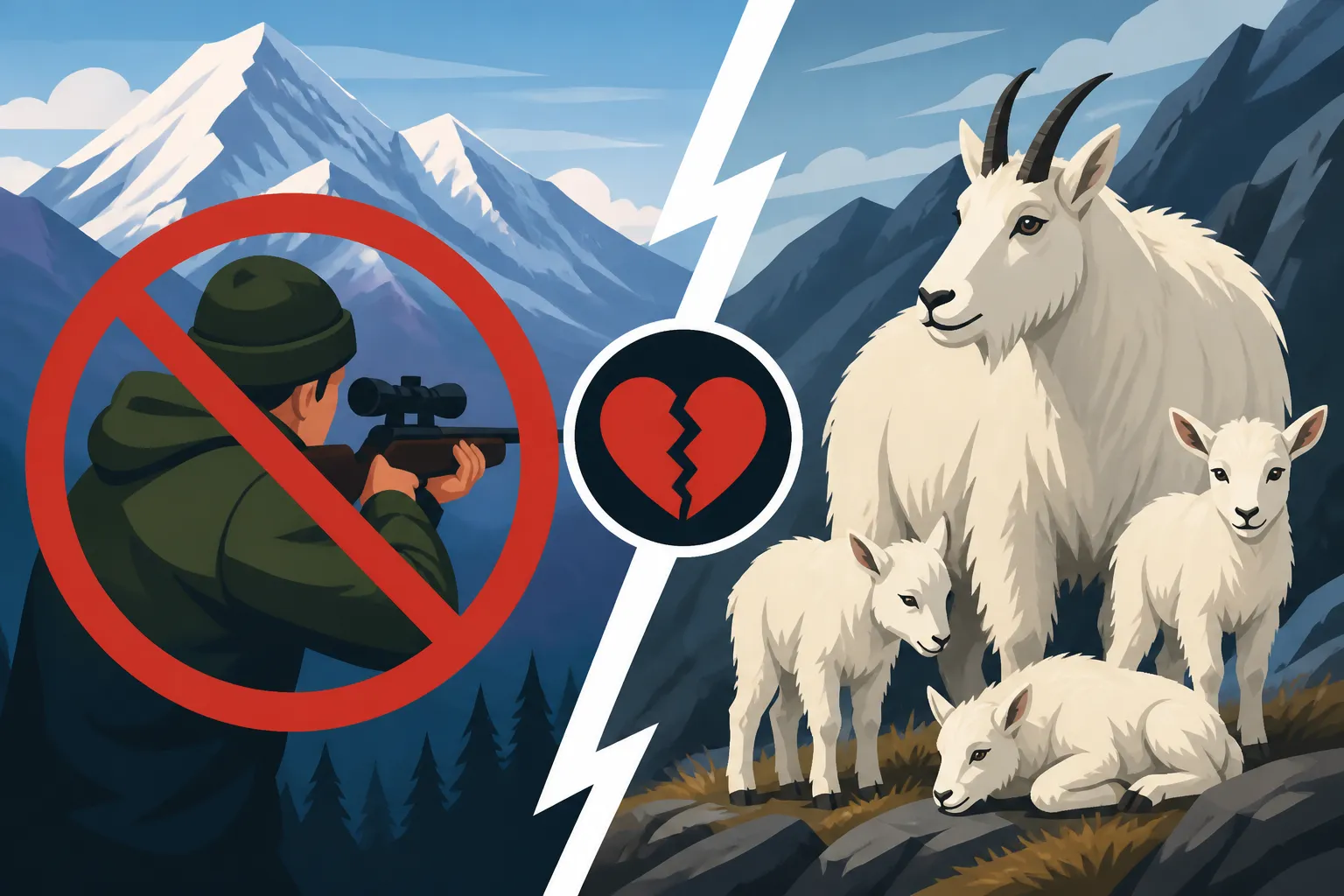
Misidentifying a mountain goat in the field can have severe, long-lasting consequences for local herds, impacting their survival for years to come. This guide will meticulously unpack why shooting a nanny goat is so detrimental to population health, how to avoid this critical mistake, and the ethical responsibilities every hunter carries in Alaska's rugged alpine environment.
The Pivotal Role of Nannies in Mountain Goat Society
Mountain goats are uniquely adapted to some of the most unforgiving terrain on Earth, relying on a specific social structure and maternal instincts to survive. Nanny goats, or females, are not just individuals; they are the bedrock of the entire herd's future. Their presence and health directly correlate with the population's ability to sustain itself.
Maternal Instincts and Kid Rearing
Nannies are the sole caregivers for newborn kids, which are incredibly vulnerable in the harsh mountain environment. A nanny will typically give birth to one, sometimes two, kids in the spring, often on secluded, precipitous cliffs that offer protection from predators like eagles and bears. For the first few months, the kid's survival is entirely dependent on its mother's milk, her guidance, and her ability to navigate treacherous terrain while keeping it safe.
The bond between a nanny and her kid is strong and crucial for the kid's development. Nannies teach their offspring critical survival skills, such as where to find forage, how to identify escape routes, and how to negotiate steep, rocky slopes. Without this essential maternal instruction, even if a kid were to survive its mother's absence, its long-term chances of reaching maturity would be significantly reduced. This generational transfer of knowledge is subtle but incredibly important in a species that lives in such extreme conditions.
Herd Leadership and Social Cohesion
While not always leading from the front, experienced nannies often serve as critical figures in the social fabric of a goat herd. They are often the ones with the most intimate knowledge of seasonal foraging areas, mineral licks, and critical escape terrain. This collective wisdom is passed down, helping the herd optimize its movements and resource utilization throughout the year.
Their presence contributes to the overall stability and health of the group. In many ungulate species, older females play a role in guiding movements and influencing group decisions, and mountain goats are no exception. Removing these experienced individuals can disrupt the social cohesion and collective knowledge base that is vital for the herd's survival through harsh Alaskan winters and predatory pressures.
Cascading Impacts on Herd Health and Future Generations
When a nanny is mistakenly harvested, the impact extends far beyond the loss of a single animal. It initiates a cascade of negative effects that can weaken the entire herd for years, primarily through reduced recruitment and genetic narrowing.
Reduced Recruitment and Population Decline
The most immediate and devastating consequence of shooting a nanny is the loss of her offspring, either an unweaned kid in tow or unborn fetuses if she is pregnant. Mountain goats have a relatively low reproductive rate compared to many other big game species, typically producing only one kid per year after reaching reproductive maturity around age three or four. This slow rate of reproduction means that the loss of even a single breeding female can have a disproportionately large impact on herd numbers.
If a nanny with a dependent kid is harvested, that kid has a very low chance of survival. It will quickly succumb to starvation, exposure, or predation without its mother's milk and protection. This means that a single mistaken shot effectively removes two or even three animals from the population – the nanny, her current kid, and any potential future offspring she would have produced throughout her reproductive life. This loss of recruitment can quickly lead to declining herd numbers, especially in smaller, more isolated populations. This is a primary reason why Why Shooting a Nanny Hurts a Goat Herd is such a critical ethical consideration.
Long-Term Genetic Narrowing and Vulnerability
Beyond the immediate numerical reduction, the long-term health of a goat herd can suffer from the removal of breeding nannies. Every individual contributes to the genetic diversity of the population. When a breeding female is removed, particularly an older, successful one, her unique genetic contribution to the future generation is lost. Over time, repeated removal of nannies can lead to genetic narrowing within a localized herd.
A genetically less diverse population is inherently more vulnerable. It has fewer tools in its genetic toolbox to adapt to environmental changes, disease outbreaks, or new predatory pressures. Imagine a herd suddenly hit by a harsh winter or a novel pathogen; a diverse genetic pool provides a better chance that some individuals will possess traits allowing them to survive and pass on resistance. By protecting nannies, hunters help ensure the long-term resilience and adaptability of Alaska's magnificent mountain goat populations. How Goats Survive Coastal Cliff Winters showcases their incredible resilience, but even that can be undermined by poor harvest choices.
Navigating the Challenges of Field Identification
Proper identification of mountain goats in the field is paramount to ethical hunting and herd conservation. However, the rugged, high-alpine environments where goats reside, coupled with their often subtle differences, present significant challenges even for experienced hunters.
Telling a Billy From a Nanny at Distance
Differentiating between a billy (male) and a nanny (female) mountain goat often comes down to observing several key characteristics, which can be incredibly difficult across vast distances or in poor light. While billies generally tend to be larger-bodied, with thicker bases to their horns and a more pronounced 'roman nose' profile, nannies also vary in size, and younger billies can appear much like mature nannies. Goats often appear as white dots against a gray cliff face, making subtle distinctions nearly impossible without high-quality optics and patient observation.
The most reliable indicators often revolve around horn characteristics and behavior. Billies typically have horns that are thicker at the base, with a more pronounced, consistent sweep backwards, and a sharper, more distinct curve at the tip. Nanny horns tend to be thinner throughout, with a more gradual, less dramatic curve, almost like a "thinner, straighter spike" at first glance, though they still have a distinct curve. However, Mountain Goat Horns on Nannies and Billies can still look surprisingly similar from far off, especially if the animal isn't broadside or if lighting is flat. This is where patience and superior glassing techniques become non-negotiable.
Environmental Factors and Optical Limitations
The mountain goat's preferred habitat—steep, broken cliffs, rock slides, and high-altitude basins—is inherently challenging for observation. Weather can shift rapidly, bringing fog, snow, or blinding glare that obscures details. Variable lighting conditions, from the harsh light of midday to the long shadows of dawn and dusk, can play tricks on the eyes, making depth and subtle differences in horn size or body mass difficult to discern. Even the best spotting scopes and binoculars have their limits. A goat that appears clearly legal through your optics might reveal crucial ambiguities upon closer inspection, ambiguities that can only be resolved by further observation or repositioning.
Before heading out, a dedicated hunter might spend hours on platforms like GoHunt, pouring over satellite imagery to identify potential goat country and plan approach routes. However, even the most meticulous pre-scouting can't fully account for the real-time conditions. Hunters must be prepared to spend significant time glassing, often hours on end, from multiple angles, observing an animal's posture, movement patterns, and group dynamics before making a decision. Utilizing resources such as GoHunt's mapping features to mark potential bedding areas or travel corridors can aid in getting into a better observation position, but the final judgment always comes down to what you see through your glass.
Here's a quick comparison of typical billy and nanny characteristics to help in the field:
| Feature | Typical Billy (Male) | Typical Nanny (Female) |
|---|---|---|
| Body Size | Generally larger, heavier build, more muscular shoulders | Smaller, lighter frame |
| Horn Base | Thicker, more substantial base, often visibly wider | Thinner at the base, tapers more quickly |
| Horn Curvature | More pronounced, consistent backward sweep, sharper tip curve | More slender, straighter profile, less dramatic curve at tip |
| Horn Length | Can be longer, but thickness and curvature are key | Often appear longer relative to thickness |
| Nose Profile | Often has a more distinct "Roman nose" (convex) | Straighter or slightly concave nose profile |
| Pelvic Patch | Prominent yellowish-brown patch, especially during rut | Less prominent or absent |
| Behavior | Often solitary or in small bachelor groups, may posture | Usually with kids, in larger ewe/kid bands, less aggressive |
| Urination | Urinates forward, often with rear legs spread | Urinates backward between hind legs |
Hunter Responsibility and Management Strategies
Ethical hunting isn't just about following the letter of the law; it's about understanding the spirit of conservation that underpins wildlife management. For mountain goats, this means taking personal responsibility to ensure your harvest contributes positively, not negatively, to the long-term health of the herd.
Adherence to "Shoot-Don't Shoot" Guidelines
Many states and provinces with mountain goat populations, including Alaska, emphasize "shoot-don't shoot" guidelines to prevent the accidental harvest of nannies. These guidelines typically urge hunters to hold off on shooting if there is any doubt whatsoever about the goat's sex. If you can't be 100% certain it's a billy, don't pull the trigger. It's a simple, yet profoundly important, rule. This often means passing on what might otherwise be a tempting shot, especially if the goat is far away, in poor light, or obscured by terrain.
Alaska's Alaska Goat Permit Hunt Structure often includes specific educational requirements, such as a mandatory goat hunter orientation, precisely to educate hunters on these critical identification issues. These orientations cover topics like Telling a Billy From a Nanny at Distance and the severe impact of nanny harvest. Hunters are urged to carry and proficiently use powerful optics, like quality spotting scopes and binoculars, to spend ample time observing animals. Sometimes, waiting for an animal to urinate or observing its interactions with other goats can provide definitive clues to its sex.
The Role of Hunter Education and Conservation
Beyond individual responsibility, collective hunter education plays a vital role in mountain goat conservation. Sharing knowledge, promoting ethical practices, and understanding the biological nuances of these animals helps create a culture of responsible hunting. Organizations, state wildlife agencies, and experienced hunters actively work to disseminate information on proper identification and the consequences of misidentification.
Hunters, through their license and tag fees, also directly fund the research and management efforts that help keep mountain goat populations healthy. By participating in surveys, providing accurate harvest reports, and engaging with wildlife managers, hunters become essential partners in conservation. Platforms like GoHunt also play a role in connecting hunters with educational resources and mapping tools that can improve their field decisions and adherence to regulations, especially in specific units like those found in the Goat Numbers in the Chugach Mountains or Kenai Peninsula Goat Populations. Ultimately, every mountain goat hunter has a critical role to play in safeguarding these iconic alpine dwellers for future generations.
Disclaimer
This article is for general informational purposes only and does not constitute professional advice. Laws, prices and regulations vary by location and change over time. Consult a qualified professional for guidance on your specific situation.