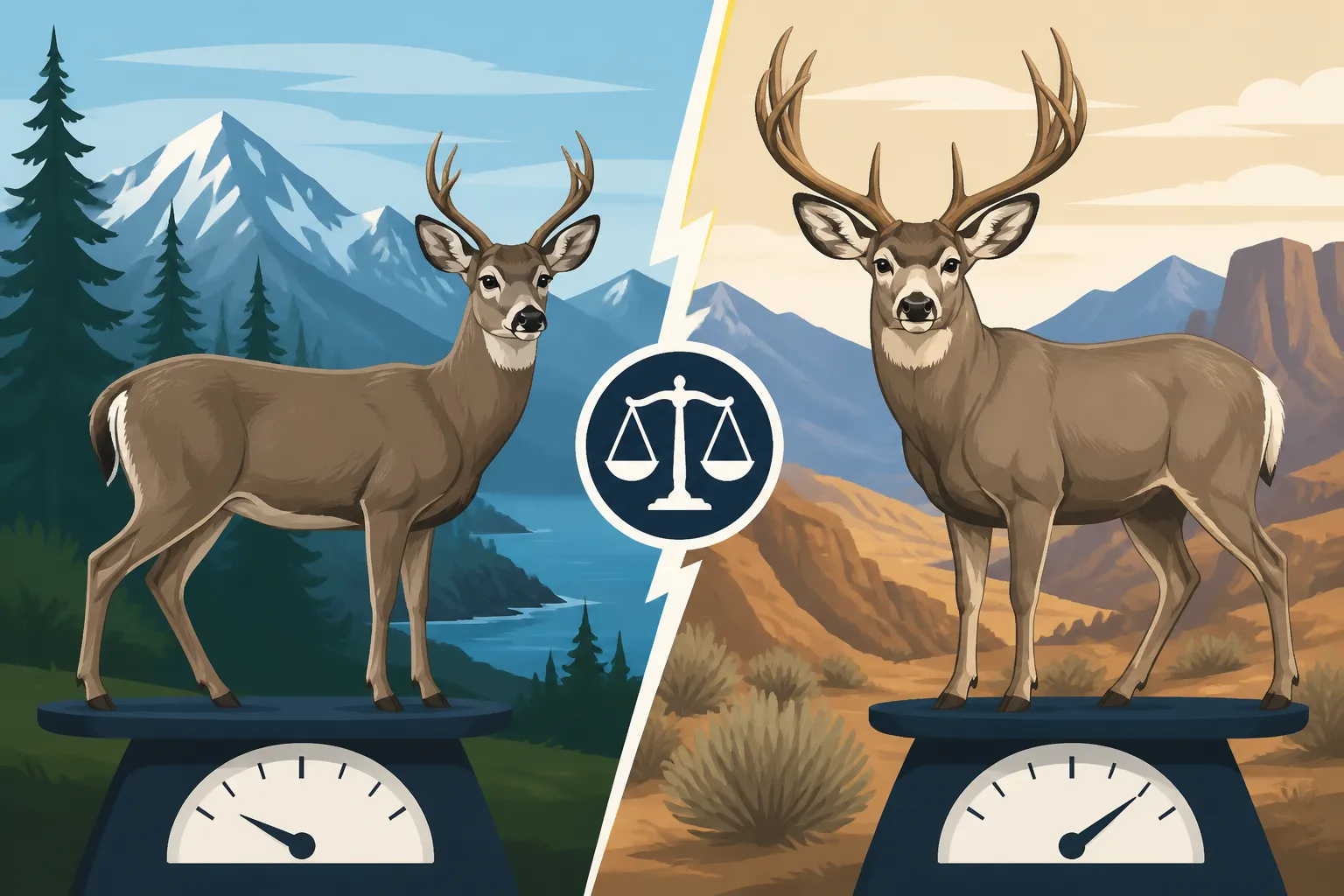
Sitka Blacktail Deer Weight Compared to Mule Deer
Trying to figure out the differences between a Sitka blacktail deer and a mule deer, especially when it comes to their size and weight, can be really confusing if you've never hunted both or seen them side-by-side. It's not just about a few pounds here or there; these are two distinct deer species adapted to vastly different environments, and that difference significantly impacts their physical stature. This guide will dive deep into what makes each deer unique in terms of weight and size, helping you understand the key distinctions and what that means for hunters.
The Compact Power of the Sitka Blacktail Deer
When you first encounter a Sitka blacktail deer, particularly in its native Alaskan rainforest habitat, you're immediately struck by its compact, almost dainty appearance compared to many other North American deer. These animals are perfectly engineered for the dense, often rugged, coastal terrain they call home. They're built for agility, for slipping through thick underbrush, and for surviving challenging winters with heavy snow loads. Their relatively smaller size isn't a weakness; it's a profound adaptation.
A mature Sitka blacktail buck, in prime condition, will typically weigh somewhere in the range of 120 to 180 pounds live weight. A robust, older buck might push past that, perhaps hitting 200 pounds on the hoof, but those are truly exceptional animals and not the norm. Does, as you'd expect, are smaller, usually falling into the 80 to 120-pound range. It's vital to remember that "live weight" is what they weigh when they're walking around; the amount of usable meat you'll pack out will be significantly less, often 40-60% of their live weight depending on how meticulously you bone it out. For a hunter on the ground, a 150-pound buck can feel like a solid meat load when you're miles from the boat or road, especially if you're Packing a Deer Off a Beach at Low Tide through mud and dense timber.
Their physical characteristics beyond weight also reflect their environment. They have a shorter body, proportionally smaller head, and relatively short legs compared to many deer species. Their antlers, while often symmetrical and aesthetically pleasing, are typically not as massive or wide as those found on larger deer. They tend to be higher and narrower, adapted for navigating dense coastal forests and alders. The deep snow winters are a real challenge for them, and you can see how their smaller size plays a role in their survival, but also how Deep Snow Winters and Alaska Deer Die-Offs can severely impact their numbers. When scouting for a hunt, understanding the local population cycles can be crucial, and resources like GoHunt can provide insights into herd health.
Understanding the Larger Stature of Mule Deer
Now, let's turn our attention to the mule deer, a quintessential icon of the North American West. Mule deer occupy a vast and varied range, from the arid deserts of the Southwest to the high alpine country of the Rockies and intermountain regions. Their physical adaptations are a testament to their life in open, often rugged, and expansive landscapes where long-distance travel and larger body mass offer advantages.
A mature mule deer buck typically commands a much more substantial presence than a Sitka blacktail. Live weights for adult bucks commonly fall between 180 and 300 pounds, with some of the largest, oldest bucks in prime habitat pushing well over 300 or even 350 pounds. This is a significant jump from the Sitka blacktail. Does are also larger than their blacktail counterparts, usually weighing between 120 and 200 pounds. Again, remember the distinction between live weight and actual meat yield. A mule deer buck can provide a substantial amount of meat, often requiring multiple trips or a strong pack string to get it all out of rough country.
Mule deer are characterized by their distinctive large ears, which are reminiscent of a mule (hence the name). They have a longer body, longer legs, and a more robust frame overall. Their antlers are also a stark contrast. Mule deer antlers typically branch, or "fork," repeatedly from the main beam, creating a wide, impressive spread with multiple points. This wider antler configuration suits their more open habitats, where they're less likely to get tangled in dense undergrowth. Their powerful legs and larger body size allow them to cover vast distances efficiently, often using a distinctive bounding gait known as "pronking" or "stotting," which helps them clear obstacles and quickly escape predators in open country. Their adaptations are all about covering ground and thriving in expansive, sometimes harsh, interior environments.
A Direct Comparison: Sitka Blacktail vs. Mule Deer Weight
The difference in average weight between Sitka blacktail deer and mule deer isn't just a minor variation; it's a fundamental distinction driven by millennia of adaptation to vastly different environments. When you lay them out side-by-side, the contrast is immediately obvious. A big blacktail might be comparable to an average mule deer doe, but it's rarely going to stand up to a mature mule deer buck in terms of sheer mass.
Let's put it into a clearer context with a comparison table:
| Characteristic | Sitka Blacktail Deer (Adult) | Mule Deer (Adult) |
|---|---|---|
| Average Buck Live Weight | 120 – 180 lbs (Exceptional: 200+ lbs) | 180 – 300 lbs (Exceptional: 350+ lbs) |
| Average Doe Live Weight | 80 – 120 lbs | 120 – 200 lbs |
| Antler Structure | Typically high, narrow, often bifurcated or small forks | Wide, branching, multiple points, often symmetrical |
| Body Build | Compact, short-legged, agile | Robust, long-legged, larger frame |
| Primary Habitat | Dense coastal rainforests, brush, islands | Arid deserts, mountains, open forests, prairies |
This table vividly illustrates the physical divide. The "why" behind this size disparity boils down to habitat, food availability, and evolutionary pressures. Sitka blacktails, found in places like Southeast Alaska, Prince William Sound, and Kodiak Island, exist in environments that are often nutrient-poor in terms of consistent, high-quality forage, especially in winter. Their dense, wet coastal forests don't always offer the same caloric abundance as the lush summer ranges of mule deer. Furthermore, navigating thick timber, steep terrain, and deep coastal snows favors a more agile, smaller-bodied animal. This is why you often see them Hunting Sitka Blacktail Deer in the Alpine Before Snow where the forage might be richer before winter sets in.
Mule deer, on the other hand, evolved in landscapes that, while harsh, often provide vast expanses of diverse forage across seasons. They thrive in environments where a larger body can store more fat for leaner times, deter predators more effectively, and cover expansive territories to find food and escape danger. The ability to grow larger is directly tied to the availability of sufficient nutrition in their range, which can be monitored with tools like GoHunt that provide harvest data and habitat analysis. The physiological demands of growing a large frame and impressive antlers require significant resources, and mule deer country, at its best, provides those resources.
For hunters, these weight differences have practical implications. A Sitka blacktail is often a manageable one-person pack-out, perhaps two trips for a larger buck if the terrain is friendly. Mule deer, particularly a large buck, almost always necessitate a two-person effort, or even more, especially when you factor in gear, meat, and the difficulty of the terrain. The meat yield will also differ significantly, with a big mule deer buck yielding substantially more venison for the freezer. Whether you're planning a trip to the Western Arctic for caribou or Kodiak for deer, knowing what to expect on the pack-out is half the battle.
Habitat and Lifestyle: Drivers of Deer Size
The environment a deer calls home is perhaps the single most influential factor determining its physical size and overall robusticity. It's a classic example of natural selection shaping a species to best suit its niche. For the Sitka blacktail deer and the mule deer, their respective habitats couldn't be more different, leading to the clear distinctions in weight we've discussed.
Let's consider the Sitka blacktail. Their prime habitat is the temperate rainforest of coastal Alaska, a world of dense timber, perpetually wet conditions, and often steep, broken terrain. Think of places like the Chugach National Forest or the islands of Southeast Alaska. This environment, while seemingly lush, presents unique challenges. The vegetation, while abundant, can be coarse, and high-quality, digestible browse isn't always plentiful, especially during the long, wet winters. Energy conservation is paramount. A smaller body mass requires less energy to sustain, less food to forage, and less effort to move through thick brush and over downed timber. Their compact build allows them to navigate intricate game trails and dense undergrowth with incredible stealth and agility. Their diet is largely dictated by what's available in these unique ecosystems, and changes in their habitat, like logging, can dramatically affect Sitka Blacktail Deer Population Cycles in Alaska. They often feed on blueberry, huckleberry, and other understory plants, along with lichens and mosses, particularly when snow covers the ground.
Mule deer, conversely, are creatures of more open, often arid or semi-arid, mountainous and prairie landscapes. From the desert sagebrush flats to the high timberline, their territories demand a different set of physical attributes. These areas, particularly during the growing season, can produce a phenomenal amount of nutritious forage – grasses, forbs, and shrubs that are rich in protein and energy. The ability to consume and process large quantities of this forage allows for significant body growth and fat storage, critical for surviving harsh winters where food can become scarce and temperatures plummet. Their larger size provides more thermal mass to withstand cold and a greater capacity to store energy reserves. The expansive nature of their habitat also means they often need to travel long distances between feeding grounds, water sources, and bedding areas. Their longer legs and larger frame are well-suited for this, allowing for efficient movement across varied terrain, whether it's bounding up a rocky slope or traversing a wide-open plain.
Even within their own species, you'll see variations. A Sitka blacktail buck on a productive island like Kodiak might be slightly heavier than one tucked away in a remote, less fertile corner of mainland Southeast Alaska. Similarly, a mule deer from the rich agricultural edges of the Great Plains will likely dwarf its counterpart eking out a living in a high-desert canyon. The principle remains: the richer the diet and the more forgiving the environment, the larger the deer can potentially grow. These environmental factors aren't just fascinating biological details; they are crucial information for any hunter looking to understand what they might encounter in the field, influencing everything from shot placement to how much game meat you'll be able to enjoy at home.
Disclaimer
This article is for general informational purposes only and does not constitute professional advice. Laws, prices and regulations vary by location and change over time. Consult a qualified professional for guidance on your specific situation.