Caribou Antler Size on Bulls and Cows
Few things are as frustrating for an Alaska hunter as trying to field judge a caribou at a distance, only to realize your initial assessment of "bull" or "cow" might be completely off. The truth is, caribou antlers are incredibly unique among North American cervids, with both sexes often sporting impressive headgear. This guide will dive deep into the fascinating world of caribou antlers, dissecting the distinct characteristics of bulls and cows to help you make confident identification calls in the vast Alaskan wilderness.
The Majestic Rack of an Alaska Bull Caribou
When you think of a "trophy" caribou, you're almost certainly picturing the magnificent antlers of a mature bull. These animals are truly in a league of their own when it comes to headgear, often growing racks that seem disproportionately large for their body size, giving them a truly primeval appearance.
Antler Growth Cycle and Characteristics
A bull caribou's antler journey begins anew each spring, a rapid growth spurt that culminates in hard, polished bone by late summer or early fall, just in time for the rut. Their antlers are typically characterized by a long, sweeping main beam that arcs backward and then often forward again. What really sets them apart, however, are the unique palmations and points that sprout from this beam.
At the base, you'll find the brow tines, which frequently flatten out into broad, forward-projecting paddles often called "shovels." Sometimes, these shovels are so developed that they almost meet over the nose, a truly impressive sight. Just above the brow tines, you'll often see the "bez tines," which can be anything from a simple spike to another small palmation. The main beam continues upward, sometimes with additional points, before terminating in a myriad of smaller tines and palmations at the top, often referred to as the "tops" or "points." The sheer variability here is astounding; no two racks are ever truly identical, making each one a unique trophy. Understanding the full antler cycle, including When Bull Caribou Shed Their Antlers, is key to appreciating their annual transformation.
Typical Antler Size and Shape
The size and shape of a bull's antlers are heavily influenced by several factors, including age, genetics, and nutritional intake throughout the year. Younger bulls, say 2-3 years old, might have more modest, spike-like antlers or smaller, less developed shovels. As they mature, typically between 5 and 9 years of age, their antlers reach their peak, boasting incredible mass, spread, and a complex array of points. A truly mature bull might have an antler spread exceeding 50 inches, with deep palmation on the shovels and numerous points throughout the tops. The mass of the antlers, particularly at the base and on the palms, is a strong indicator of age and health.
The defining characteristic for many hunters is the "caribou shovel" or "double shovel," where both brow tines form prominent, palmated structures. While not every bull will have perfectly symmetrical shovels, their presence and development are a hallmark of a mature male. These impressive structures serve not only as a display of dominance during the rut but also as tools for fighting and scraping against brush.
Variations and Anomalies
It's important to remember that nature doesn't always adhere to perfect symmetry or textbook examples. You'll encounter bulls with racks that are asymmetrical, broken, or simply unique. Injuries sustained during fighting or migration can lead to malformed antlers in subsequent years. Nutritional deficiencies, especially during harsh winters, can also impact antler growth, resulting in smaller or less robust racks. Don't be surprised to see a mature bull with a less-than-perfect set of antlers; these variations are a part of their wild beauty. Field judging often requires accounting for these natural anomalies, and it's where resources like GoHunt can provide historical data on antler quality in specific hunting units, helping you set realistic expectations for the area you're pursuing caribou.
Understanding Cow Caribou Antlers
For many hunters unfamiliar with caribou, the idea of a cow with antlers can be quite surprising, even confusing. Unlike most other deer species where antlers are almost exclusively a male trait, a significant percentage of female caribou—often upwards of 80-90% in some herds—grow antlers. This unique adaptation serves several crucial purposes in the harsh Alaskan environment.
The Unique Aspect of Antlered Cows
Imagine glassing a vast tundra expanse, and you spot what looks like antlers bobbing above the willows. Your immediate thought might be "bull!" but with caribou, that's not always the case. Antlered cows are a common sight, and understanding their antler characteristics is absolutely essential for making sound hunting decisions and avoiding misidentification. The presence of antlers on female caribou is an evolutionary advantage, providing them with crucial tools and social standing within the herd.
Cow Antler Purpose and Structure
Why do cow caribou grow antlers? The primary theory suggests it's a matter of survival, especially during the challenging winter months. Antlers allow pregnant cows to compete more effectively with bulls for prime feeding spots on winter ranges, where digging through snow to access lichen can be arduous. It also provides a measure of protection against predators, though they primarily rely on the herd for safety.
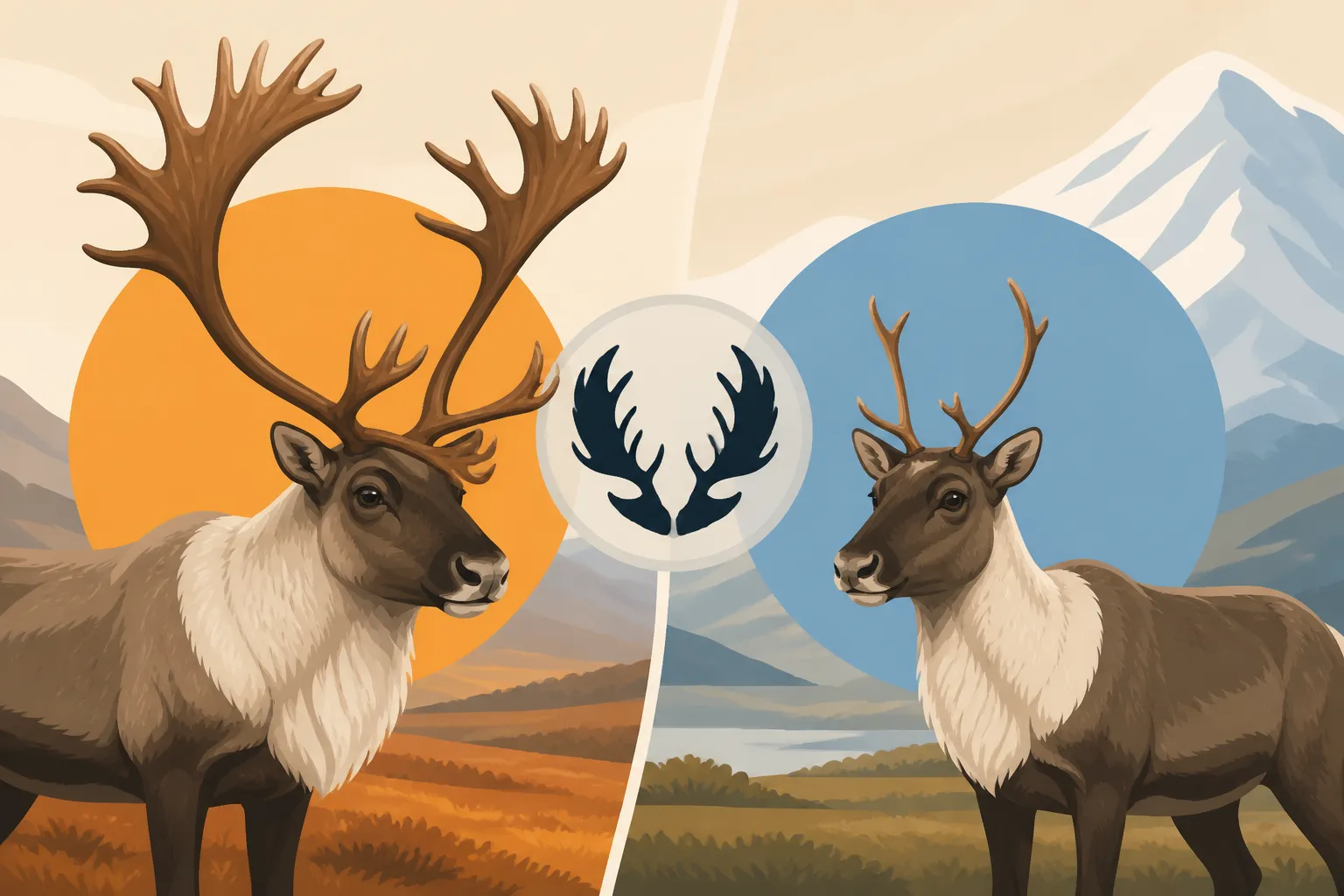
Structurally, cow caribou antlers are generally much smaller, thinner, and less palmated than those of bulls. While they do have a main beam, it's typically more slender, with less curvature, and often lacks the pronounced mass and intricate palmation seen in a bull's shovels. Their brow tines might be present but are usually simple spikes or small, flattened nubs rather than broad paddles. The tops are also much less developed, often consisting of just a few spindly points or a single fork. It's rare to see a cow with anything approaching the robust, sweeping rack of a mature bull.
Timing of Antler Shedding in Cows
Perhaps one of the most critical distinguishing factors, especially later in the hunting season, is the timing of antler shedding. Unlike bulls, who typically shed their antlers in late fall or early winter after the rut, pregnant cow caribou often retain their antlers well into the spring, sometimes even until after they calve in May or June. This extended period of antler retention gives them an advantage during late-season foraging when food is scarce and competition is high.
This physiological difference means that if you're hunting in late November or December, and you see an antlered caribou, there's a good chance it's a cow, as most mature bulls would have already dropped their racks. This phenomenon is a key element in Why Cow Caribou Keep Antlers Longer and something every Alaska hunter needs to commit to memory. This is a perfect example where precise field identification is crucial to avoid mistakenly harvesting an animal outside the legal season or sex restrictions.
Key Differences for Field Identification
Accurately distinguishing a bull from a cow caribou in the field, especially at varying distances and light conditions, is a skill honed through experience and careful observation. It's not just about the antlers, but how they integrate with the animal's overall physique and behavior.
Comparative Analysis of Antler Features
When glassing a caribou, your eyes should immediately go to the antlers and begin a rapid assessment of several key features. Think about the mass of the antlers: do they appear thick and heavy, particularly at the base and throughout the main beam? Or are they slender and delicate? Bull antlers will almost always have significantly more mass. Next, look for palmation, especially the shovels. Are there broad, flat, forward-projecting paddles above the eyes? These are the hallmark of a bull. Cow antlers, if present, might have small, flat brows, but rarely the extensive palmation.
Consider the length and curvature of the main beam. A bull's beam tends to sweep back and then forward, creating a more dramatic arc, often with additional points along its length. Cow antlers are typically shorter and straighter, with less complex branching. Finally, examine the tops – the upper portion of the antlers. Bulls will generally have more points, and often more extensive palmation, creating a "basket" or "crown" effect. Cows will have simpler, often spike-like or sparsely branched tops. It's helpful to remember that Caribou Antler Shedding and Bull Identification can sometimes be tricky with younger bulls or older cows, requiring you to look for a combination of clues.
Here's a quick comparison table:
| Feature | Bull Caribou Antlers | Cow Caribou Antlers |
|---|---|---|
| Mass/Thickness | Significantly thicker and heavier, especially at base. | Thinner, more delicate throughout. |
| Brow Tines | Often broad, palmated "shovels" that project forward. | Typically simple spikes or small, flat nubs; rarely large. |
| Main Beam | Long, sweeping, often with distinct forward and backward arcs. | Shorter, straighter, less dramatic curvature. |
| Tops/Points | Numerous points, often with palmation ("basket" effect). | Fewer, simpler points, often spike-like or sparsely branched. |
| Symmetry | Can be quite variable, but often impressive overall structure. | More consistently simple, less robust. |
| Shedding Timing | Shed after rut (late fall/early winter). | Often retain through winter and into spring (until calving). |
Body Size and Behavior as Ancillary Cues
While antlers are the primary identification tool, never underestimate the power of other physical characteristics and behaviors. Bull caribou are generally larger and more robust than cows, with thicker necks, especially during the rut when their neck muscles swell. Their overall body mass will appear greater. Pay attention to their gait and how they carry themselves; bulls can often appear more deliberate and powerful.
Behavior can also offer clues. During the rut (typically late September through October), bulls are often seen chasing cows, sparring with other bulls, or exhibiting more aggressive displays. Cows, particularly those with calves, will often be more attentive to their young and may move in tighter groups. Observing how a caribou interacts with others in the herd can sometimes confirm your antler-based assessment. Many hunters use tools from GoHunt to study historical harvest photos from specific units, which can help calibrate their eyes to typical body and antler sizes for that region.
The Challenge of Sub-Legal Bulls vs. Large Cows
This is where the real frustration sets in for many hunters. Sometimes, a young bull (say, a "spike-fork" or a bull with very modest antlers) can have a rack that, at a glance, might be confused with a large, antlered cow. Conversely, an exceptionally robust cow might grow a more developed set of antlers than average, leading to misidentification.
Factors like distance, mirage, poor light, or obscured views (e.g., only seeing the top half of the antlers above brush) exacerbate this challenge. This is why patience and careful observation are paramount. Use your optics to scrutinize every detail, wait for the animal to move into better light or a clearer position, and try to observe it alongside other caribou for comparison. Rushing a shot based on a quick glance can lead to mistakes, which can have serious legal repercussions under Alaska's strict game laws regarding sex and antler restrictions.
Factors Influencing Caribou Antler Development
Caribou antlers are not static; their size, mass, and complexity are dynamic features influenced by a complex interplay of environmental and biological factors. Understanding these elements can give you a better appreciation for the animal you're hunting and inform your scouting efforts.
Age and Genetics
Just like humans, caribou have a prime in their lives. For bulls, peak antler growth typically occurs between 5 and 9 years of age. Before this, antlers are generally smaller, and after this, as a bull ages past his prime, his antlers may start to regress in size and mass. It’s not uncommon to see a very old bull with a respectable but not record-breaking rack. Genetics, of course, play a fundamental role. Some bloodlines simply have the predisposition to grow larger, more impressive antlers. Even with perfect nutrition, a caribou without the right genetic blueprint won't produce a massive rack. This is why observing patterns in particular Caribou Herds of Alaska and How They Move over many seasons can sometimes give insights into the genetic potential of animals in that area.
Nutrition and Habitat Quality
No factor impacts antler growth more directly than nutrition. Antlers are bone, and bone growth requires a huge amount of calcium, phosphorus, and other minerals, as well as protein and energy. Caribou rely heavily on lichen, especially during winter, but spring and summer foraging on green vegetation like willows, sedges, and forbs are critical for building up reserves for antler development. A caribou herd living in a rich, productive habitat with abundant, high-quality forage will, on average, produce larger antlers than a herd struggling in a poorer environment.
Consider a herd like the Fortymile Caribou Herd Size Today, which has experienced fluctuations in population and range. Changes in their habitat, whether due to wildfire, climate, or industrial development, can impact the availability and quality of their food sources, and in turn, their antler growth. Hunters often study migration corridors and feeding grounds, sometimes using satellite imagery analysis through platforms like GoHunt, to pinpoint areas that are more likely to support well-nourished animals. The nutritional bounty found along routes like the Nelchina Caribou Movement Along the Denali Highway contributes significantly to the health and antler development of those animals.
Herd Health and Population Dynamics
The overall health and density of a caribou herd also play a significant role. In a healthy, well-managed herd with a balanced population size relative to its habitat, competition for resources is generally manageable, leading to better antler growth. However, if a herd becomes overpopulated, the increased competition for food can lead to reduced nutritional intake for individual animals, resulting in smaller body sizes and diminished antler development across the board. Conversely, a declining herd, while perhaps offering less competition, might also indicate underlying environmental issues that could negatively impact antler growth.
Disease, parasites, and predation pressure can also drain a caribou's energy reserves, diverting resources away from antler growth. Understanding these population dynamics, often studied by wildlife biologists, helps game managers set appropriate harvest limits and regulations. As a hunter, being aware of the general health of the caribou herd you're pursuing—for example, knowing the caribou population objective range for a particular herd—can influence your expectations for antler size.
Ultimately, whether you're chasing a massive bull or simply hoping to fill your freezer, appreciating the intricate details of caribou antlers—from the robust shovels of a bull to the delicate rack of a cow that defies conventional wisdom—makes the experience all the more rewarding. It demands patience, keen observation, and a deep understanding of these magnificent creatures. This knowledge, coupled with an understanding of rules like Caribou Tags That Residents Do Not Have to Buy or the Caribou Tag Price for an Alaska Nonresident, ensures a responsible and successful hunt.
Disclaimer
This article is for general informational purposes only and does not constitute professional advice. Laws, prices and regulations vary by location and change over time. Consult a qualified professional for guidance on your specific situation.