Bear Spray Versus Rifle at Close Range
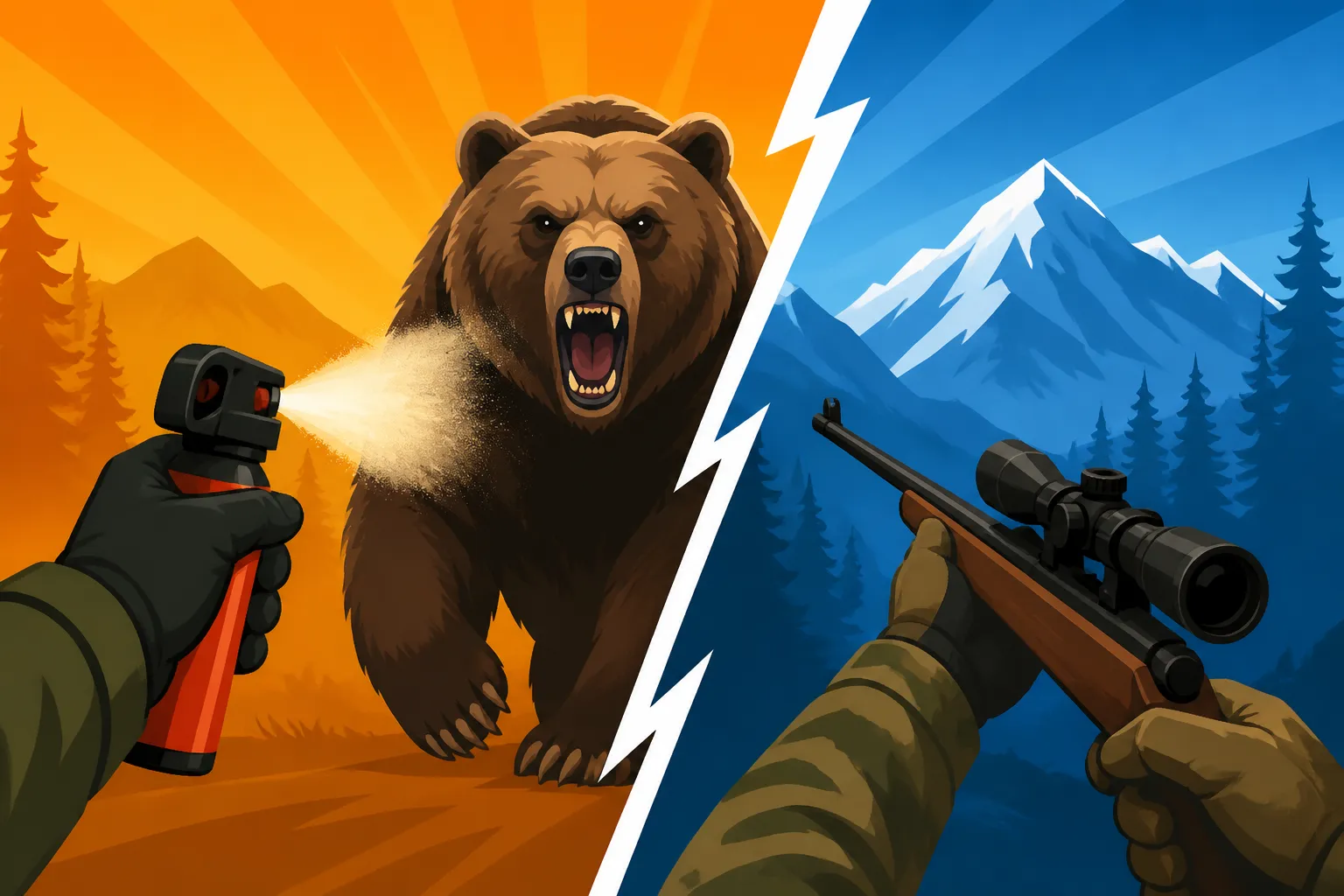
When you're out in the vast wilds of Alaska, the possibility of an unexpected, close-range encounter with a bear is a stark reality that every hunter and outdoors enthusiast must acknowledge. These aren't always textbook, long-distance sightings; sometimes, you're practically on top of a bear before you even know it, and the stakes couldn't be higher. This guide will walk you through the critical considerations of defending yourself at close quarters, specifically comparing bear spray and a firearm, and how to make the best decision when seconds count.
The Inevitable Close Encounter
The serene beauty of Alaska's backcountry can be deceptive. While most bear encounters are benign, those sudden, close-range situations can escalate from zero to terrifying in an instant. This isn't just a concern for those actively pursuing bears; anyone hiking a game trail, calling moose, or packing out meat in the thick alders can find themselves in a precarious position. The critical takeaway is that preparedness isn't about if it happens, but when and how you react.
Understanding Bear Behavior in Defensive Situations
Bears, both black and brown, are incredibly powerful animals, and understanding their behavior is key to anticipating and potentially de-escalating a dangerous situation. Most charges are what we call "bluff charges" – a bear trying to scare you off, often involving jaw-popping, huffing, and ground-swatting. They might run towards you, stop abruptly, and then turn away. However, some charges are genuine, driven by a bear feeling threatened, defending cubs, or protecting a food source. A sow with cubs or a bear on a fresh kill, especially a large one like a moose, can be particularly aggressive. Recognizing the difference in the heat of the moment is incredibly difficult, which is why a rapid, decisive response is paramount. This is a critical aspect of general bear safety, especially when you're Working a Kill Site in Grizzly Country.
The Speed of an Attack
If a bear decides to charge, whether it's a bluff or the real deal, it happens at an astonishing speed. Bears can run upwards of 35 miles per hour, covering ground faster than any human can react or run away. This means that a bear 20 yards away can be on you in just over a second. This incredibly short reaction window leaves almost no time for deliberation. You need to have your defense ready, know exactly how to deploy it, and commit without hesitation. The adrenaline dump alone can make fine motor skills disappear, so repetitive practice with your chosen defense tool is not just recommended, it's essential.
Bear Spray: Your First Line of Defense
Many experienced Alaskans and wildlife professionals advocate for bear spray as the primary defense in most close-range bear encounters, especially for those that are defensive in nature. It's non-lethal, effective, and can stop a charging bear without requiring perfect aim or ethical dilemmas.
How Bear Spray Works
Bear spray is an aerosol deterrent containing capsaicin and related capsaicinoids, which are highly inflammatory compounds derived from chili peppers. When deployed, it creates a cloud of these irritants, impacting the bear's respiratory system, eyes, and mucous membranes. This causes immediate, intense burning sensations, temporary blindness, difficulty breathing, and an overwhelming desire for the bear to escape the irritant cloud. The goal isn't to hurt the bear long-term, but to incapacitate it long enough for you to safely retreat. It's crucial to check the expiration date on your bear spray, as its effectiveness can diminish over time. Always carry a fresh can, especially when venturing into critical areas like those described in Alaska Brown Bear Spring and Fall Seasons.
Deploying Bear Spray Effectively
Effective deployment of bear spray is all about readiness and aiming. It needs to be immediately accessible, not buried in your backpack. Many hunters carry it in a chest holster or on their hip. When a bear charges, you should remove the safety clip with your thumb, aim slightly downward at the charging bear's face or chest, and unleash a continuous 2-3 second blast. The idea is to create a defensive cloud that the bear runs into. Don't wait until the bear is right on top of you; aim to deploy when it's still 10-20 yards away, giving the spray time to expand and the bear time to react. If the bear continues, follow up with another short burst. Remember, the goal is to hit the bear's sensitive areas with the irritant.
Limitations and Considerations
While highly effective, bear spray isn't foolproof. Wind is its biggest enemy. A strong crosswind or headwind can blow the spray away from the bear or, worse, back into your face, incapacitating you instead. Always be aware of wind direction, if possible, before deployment. Distance is another factor; most sprays are effective out to about 25-30 feet (7-9 meters), so you need to let the bear get relatively close. Extreme cold can also affect canister pressure, reducing spray distance and duration, though most modern brands like Counter Assault or UDAP are formulated to perform in cold temperatures. Finally, ensure your can is full and has not expired. The manufacturer's instructions, often found on the GoHunt website or directly on the product, emphasize proper storage and maintenance.
The Rifle: When Lethal Force Is Necessary
For many, the rifle represents the ultimate defense, capable of stopping any animal if used effectively. In Alaska, where brown bears can weigh over a thousand pounds, a powerful rifle is often seen as a necessary tool, especially when hunting big game. However, using a rifle in a close-range charge is a last resort and demands a very specific skill set under immense pressure.
Rifle Selection for Bear Country
Choosing the right rifle for bear country isn't just about big caliber, it's about reliability and stopping power. For coastal brown bears, many guides and experienced hunters recommend .338 Winchester Magnum, .375 H&H Magnum, or even larger calibers like the .416 Remington Magnum. The key is heavy, controlled-expansion bullets designed for deep penetration. Lever-action rifles in calibers like .45-70 Government with heavy bullet loads are also popular for their quick follow-up shots in dense cover. A bolt-action rifle, while powerful, might be slower for subsequent shots. The most important factor, regardless of caliber, is that you are proficient with your chosen rifle. You can learn more about Rifle Calibers for Coastal Brown Bear.
Critical Shot Placement for Stopping a Charge
Stopping a charging bear with a rifle requires precise shot placement under duress, and this is where the real challenge lies. The target area on a charging bear is incredibly small and rapidly moving. A frontal brain shot is immediately incapacitating but incredibly difficult to execute. More realistically, you're aiming for the central nervous system (brain/spine) or the vitals (heart/lungs). A heart or lung shot will certainly be lethal but might not stop the bear before it reaches you. The goal is to break the bear down physically – shattering shoulder bones, severing the spine, or destroying the brain. This demands a cool head, quick target acquisition, and the ability to put multiple rounds precisely on target, which is exceptionally hard when a thousand pounds of fur and teeth are closing in fast.
The Mental and Physical Challenge of a Close-Range Shot
The psychological and physiological impact of a charging bear cannot be overstated. Your heart will be pounding, vision tunneling, and fine motor skills can disappear. Sighting in on a rapidly approaching, adrenaline-fueled bear at spitting distance requires a level of mental fortitude and training that few possess. There’s no time to check your breathing, settle your crosshairs, or adjust your stance. It's a reaction, pure and primal. Furthermore, the recoil of powerful bear cartridges can make quick follow-up shots difficult, and any flinching can lead to a missed shot, turning a bad situation catastrophic. This is why some hunters also carry a powerful sidearm for a last-ditch effort, a concept explored in Carrying a Sidearm Around a Kill Site.
A Head-to-Head Comparison: Spray Versus Rifle
The debate over bear spray versus a rifle often falls into an "either/or" trap, but the reality in Alaska is often "and." Both tools have their place, their strengths, and their limitations. Understanding when to reach for which is the mark of a truly prepared individual.
Pros and Cons of Each Method
Let's break down the practical advantages and disadvantages of each defense method in a close-range encounter. This table provides a quick reference, but remember, individual situations can vary wildly.
| Feature | Bear Spray (e.g., Counter Assault) | Rifle (e.g., .375 H&H Magnum) |
|---|---|---|
| Effectiveness | High success rate in defensive encounters (non-lethal incapacitation). | High potential for lethal incapacitation if shots are well-placed. |
| Aiming Required | Less precise aiming required; creates a cloud barrier. | Extremely precise aim required for critical stopping shots. |
| Learning Curve | Relatively easy to learn quick deployment and effective use. | Requires extensive practice, proficiency, and calm under extreme pressure. |
| Safety for Bear | Non-lethal; allows bear to recover and learn to avoid humans. | Lethal; results in bear death, which may not be desired or necessary. |
| Environmental | Affected by wind, temperature; limited range (25-30 ft). | Unaffected by wind; effective at greater distances, but still challenging up close. |
| Ethical Concerns | Generally none, as it is non-lethal. | Significant, as it results in the death of the animal. |
| Psychological Toll | Less severe, as the outcome is non-lethal. | Can be severe due to killing an animal in self-defense. |
| Legality | Generally unrestricted for carry. | Requires licensing, adherence to hunting regulations, specific calibers. |
| Risk to User | Low risk of blowback with proper deployment; no projectiles. | Risk of overpenetration, ricochet, and failure to stop the charge. |
The "And" Not "Or" Approach
The most prudent approach for anyone venturing into Alaska's true wilderness is to carry both bear spray and a powerful firearm, and perhaps even understand how to set up a Bear Fence Setup at a Meat Cache. This isn't about choosing one over the other, but recognizing their complementary roles. Bear spray is often the best choice for defensive encounters at very close range (under 20 yards) where a charging bear is simply trying to neutralize a perceived threat. Its non-lethal nature and "area of effect" make it ideal for quickly deterring a charge without the need for pinpoint accuracy, which is often impossible in a high-stress situation.
A rifle, on the other hand, becomes essential when spray fails, or when facing a predatory attack, or when you are actively hunting large, dangerous game and need decisive stopping power. It's a critical backup for when lethal force is the only option left. Think of bear spray as your immediate deterrent and the rifle as your ultimate, last-ditch defense. Carrying both allows you to assess the situation and choose the appropriate tool for the specific threat, giving you the best chance of survival. This dual-tool approach is widely recommended by Alaska Department of Fish and Game and seasoned Alaskans who understand the varied and unpredictable nature of bear encounters in units like Hunting Unit 13 and the Nelchina Basin.
Ultimately, the best defense is always prevention. Make noise, carry your defenses ready, know how to use them, and be constantly aware of your surroundings. And don't forget to check resources like GoHunt for updated bear safety tips and product recommendations before heading out.
Disclaimer
The information provided in this article is for educational and informational purposes only and does not constitute professional advice. Bear encounters are inherently dangerous and unpredictable. Always follow local regulations, consult with experienced professionals, and prioritize safety. The author and publisher are not responsible for any actions taken based on the information in this guide.